Peck Kee Lin, See Pang Neo




| Inscription 碑文 | 白麒麟 施妨娘 光绪廿八年正月廿七日 民国九年庚申陽月初二 麒麟白公 妨娘白門施氏 孝男金泗金標 女珠娘 孫松慶 仝立 |
| Translation 譯文 | Peck Kee Lin (romanised) See Pang Neo (romanised) Guangxu 28th year, 1st moon, 27th day [6 March 1902] Republic of China 9th year, geng-shen, 10th moon, 2nd day [1920] Late beloved father Peck Kee Lin Late beloved mother See Pang Neo, of the See clan, married into the Peck family Filial sons Kim See, Kim Piew Daughter Choo Neo (romanised) Grandson Song Keng (romanised) Jointly erected |
| Era / Dynasty 年代 | 光绪 Guangxu / 民国 Republic of China |
| Year 年份 | 1902 |
| Final Resting Place e.g. Bukit Brown · Lao Sua · Kopi Sua · Bukit Cina · Columbarium | Lao Sua Hill 138 (temple hill) |
| Block No | |
| Division | |
| Plot No | |
| Year of Burial | 1902, 1920 |
| Name (Chinese) 姓名 | 白麒麟、施妨娘 |
| Name (Romanised) 英文名 | Peck Kee Lin, See Pang Neo |
| Clan / Family 族群 | 白門 Peck family |
| Relationship 關係 | 白公 (deceased father), 白門施氏 (deceased mother of See clan, married into Peck family) |
| Name (Chinese) 姓名 |
Name (Romanised) 英文名 |
Relationship 關係 |
| 金泗 | Kim See | 孝男 — filial son |
| 金標 | Kim Piew | 孝男 — filial son |
| 珠娘 | Choo Neo | 女 — daughter |
| 松慶 | Song Keng | 孫 — grandson |
Tile I · The Sow with Piglets
Transfer-printed blue-and-white earthenware · British manufacture · c. 1895–1910
The first tile depicts a large sow standing in profile, surrounded by several piglets in a farmyard setting. A rustic wooden fence is visible to the right of the composition. The scene is rendered in cobalt blue against a white tin-glazed ground using the transfer-printing technique — a process in which an engraved copperplate design is transferred via tissue paper onto the unfired ceramic surface, producing fine, consistent pictorial detail at industrial scale.
The tile surface shows pronounced crazing — a dense network of fine hairline fractures in the glaze — consistent with over a century of age and thermal cycling. Dark grime has settled into the craze lines and surface pitting, lending the tile its characteristically mottled, antique appearance. Despite this, the pictorial quality of the image remains remarkably legible.
Farmyard scenes — cattle, pigs, poultry — were a standard repertoire for transfer-printed hearth and fireplace surround tiles in British manufacture from the 1880s through the 1910s. It is likely this tile originated as a domestic hearth tile, purchased through Singapore's import trade for use in tomb construction. Within the Chinese funerary tradition at Bukit Brown, decorative tiles were selected for their aesthetic qualities and availability, whatever their original Western domestic purpose.
The symbolism is also worth noting: in Chinese culture, the pig carries associations of wealth, abundance, and good fortune — a propitious image to accompany the deceased into the afterlife, even if the tile's original makers had no such intent.
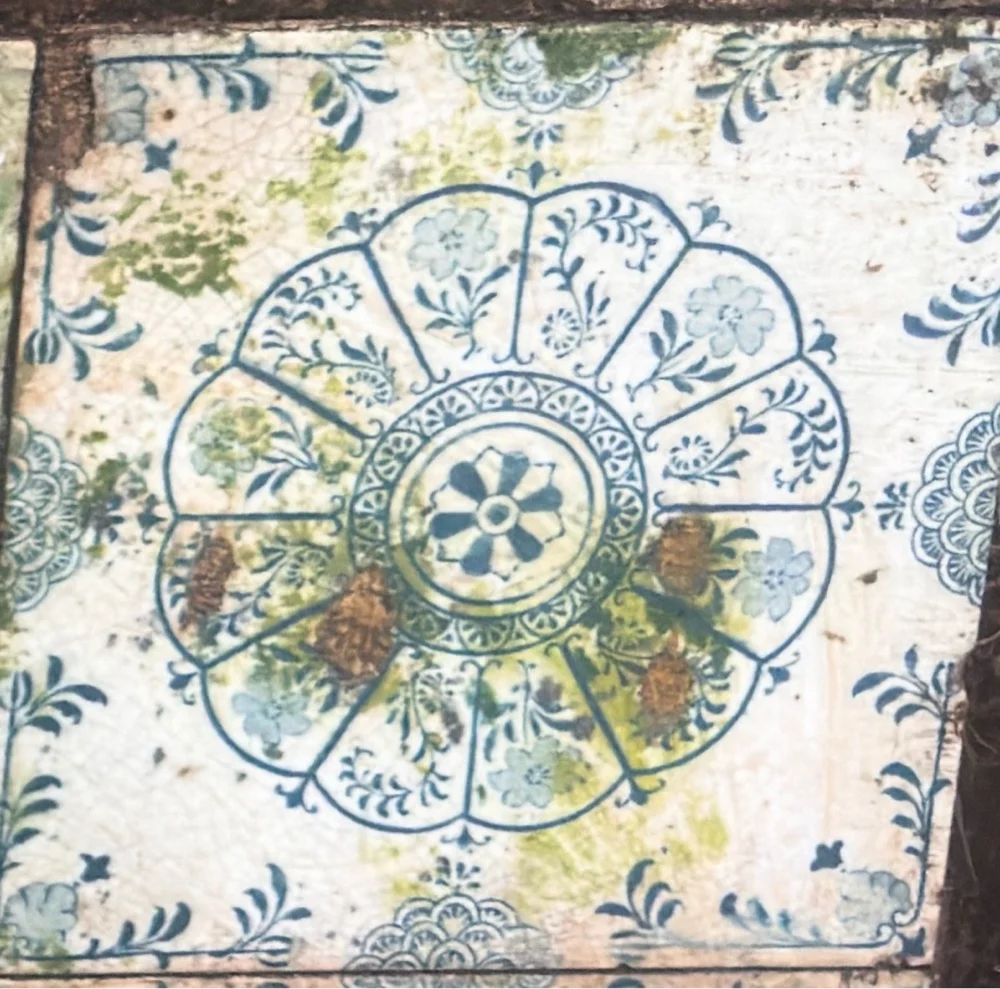
Tile II · The Floral Medallion
Transfer-printed blue-and-white earthenware · British manufacture · c. 1895–1910
The second tile presents a formal radial floral medallion: a central rosette, encircled by a band of lace-like ornamental detail, from which eight petal-shaped segments radiate outward. Each segment contains a distinct botanical spray — flowering stems, leafy branches, and stylised blooms — rendered in the same cobalt blue transfer-print technique as the pig tile. The outer corners carry additional floral sprays, and a geometric border frames the overall composition.
The design is characteristic of Aesthetic Movement tile patterns produced by British manufacturers in the 1880s–1900s, blending Near Eastern geometric structure with naturalistic botanical draughtsmanship. Similar tiles were produced by firms in Staffordshire and Lancashire — the two regions that dominated the British ceramic tile industry during this period, and from which Singapore's tile imports overwhelmingly derived.
The tile has suffered significant physical damage: a large diagonal crack runs across its lower half, opening into a structural break with sections of surrounding mortar fragmenting away. Despite this, the transfer-printed decoration on the surviving upper portion remains crisp — a testament to the durability of fired cobalt pigment under the glaze.
A near-identical floral medallion tile has been documented at Greenbank, St Helens, Lancashire — catalogued by the St Helens Heritage Hub as a Victorian hearth tile of circa 1900s. The match directly corroborates the dating of this tomb.
The identification of a near-identical tile at Greenbank, St Helens — documented by the St Helens Heritage Hub and dated to circa 1900s — provides important corroborating evidence for the dating of this tomb. The tile was found installed in a house in Greenbank; British transfer-printed hearth tiles of this period were typically manufactured in Staffordshire and Shropshire, distributed widely across Britain and exported through colonial trade networks to markets including Malaya and Singapore. The 1902 date on the tomb inscription aligns precisely with the production period of both tile designs.
That a matching tile can be traced to a surviving example in St Helens, Lancashire gives this find a broader resonance: a grave bearing the name of a mythical creature in Bukit Brown is connected, through a humble farmyard tile, to the same industrial production line that furnished the fireplaces of Victorian England.
Comments
Post a Comment