The Bukit Timah Cemetery opened for burials on April 1, 1865. Located two miles from town then. The Cemetery is divided between the Roman Catholics and Christians of other denominations; the Catholic portion with its mortuary chapel is on the left as one enters the gate, the Protestant section and Mortuary chapel are on the right...."
1893 Map
1913 map


Buckley commenting on the cemetery records that "...when the new cemetery in Bukit Timah Road was laid out, the two divisions were .... separated by the broad centre path leading from the present turnstile, which, within the last few years, has taken the place of the large central archway, through which the coffins always used to be carried...."
The Municipal records show that the cemetery land was purchased from the Honourable East India Company on 22nd January 1864 "...by Indenture No72 of the District of Claymore
The cemetery was later extended with the new section being opened on the western side but the two sections were separated by a small road that later was to become New Cemetery Road. The 1907 Handbook To Singapore shows the road as being unnamed.
The eastern side of the cemetery, adjacent to the Kampong Java Road, continued to be subject to flooding and eventually all attempts to bury in that area were abandoned.
The need to provide another cemetery was discussed early in the new century and by 1902 the question of the purchase of land for the new cemetery was under active consideration. The new cemetery, adjacent to the Serangoon Road, was first used in 1907 and became known as the Bidadari Christian Cemetery.
5 burials with no headstones
Although the Bukit Timah Cemetery was available for burials from 1 April 1865 the first burial took place on 15 April 1865 when an un-named Dutch seaman was buried in the Protestant Section. The next burials took place on 16th and 17th April and were the five European casualties from the accident that occurred on Saturday afternoon, 15th April, when the iron screw steamer, the Johore blew up off Dalhousie Pier. The vessel which had newly-arrived from England was being made ready for a picnic party which was to include the owner, the Tumongong of Johore, and the Governor and which was to take place on Easter Monday. The death toll from the accident was about thirty, the exact number is not known as it was uncertain how many Malays were on board at the time. Five Europeans and two Chinese were amongst those killed, the remainder being Malays.
The first three Europeans were buried at 3pm on Easter Sunday 16 April 1865 with the service being taken by the Reverend C J Waterhouse MA.
The three men buried were:
Captain Cleghorn Master of the Ship Henrietta.
John Young Gunner of the Steamer 'Johore' (he was the only European seaman on board).
Henry Sandhurst Boiler Maker of the New Harbour Dock Company.
On the following day the other two European casualties were buried. These were:
John Miller Engineer Officer of the Steamer 'Johore'.
Hugh Bain Engineer of the New Harbour Dock Company.
The five graves were never given headstones but are recorded as being "...situated at the corner of the first plot of ground on the right of the centre path after passing the path that turns to the right leading to the Chapel...."
The burials ceased in the Bukit Timah Cemetery early in 1907 and from that time on the cemetery was maintained by the Public Works Department but by 1956 the walls of the cemetery had been demolished and the cemetery was by then very over-grown by trees and shrubs and the eastern end was frequently flooded. Many of the memorials had collapsed and quite a number of the inscriptions had become illegible or had been damaged.
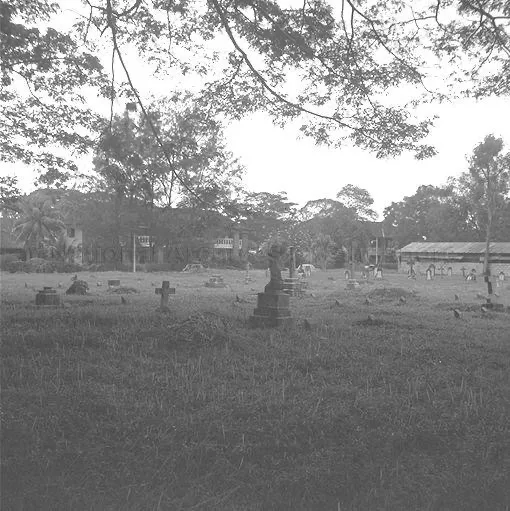
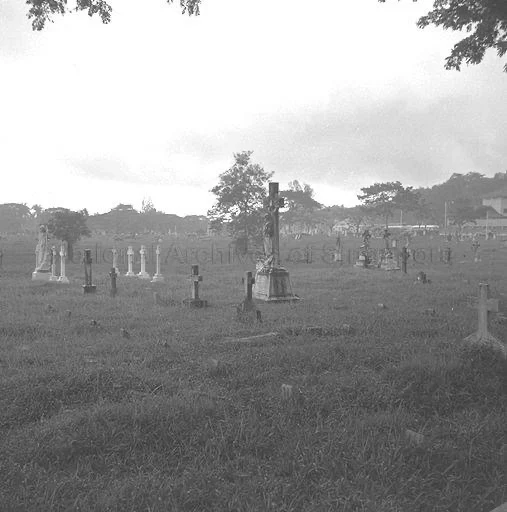
The cemetery was finally closed to all visitors in 1971 and the area was cleared of all gravestones and memorials and exhumation of some remains was carried out by the Singapore Cemeteries Board. The area was then landscaped, planted with trees and flowering bushes and converted into a Peoples Park. Unfortunately the majority of the memorials were destroyed at this time. However one military memorial was saved and transferred to the Ulu Pandan Military Cemetery. This was a memorial to members of the Corps of Royal Engineers who lost their lives whilst serving at Singapore.
Twelve other memorials were saved and removed to the old Fort Canning Cemetery and re-erected in the north-east corner of that cemetery.
Reference
Extracted from the Book Early Cemeteries in Singapore by Major Alan Harfield (1926–2013) and Published by the British Association for Cemeteries in South Asia (1988)
He was a British soldier, historian, and author who is widely considered one of the foremost authorities on the British colonial military history of Singapore and the Far East.
Exhumation notice published in Straits Times 3 Dec 2025
Based on this notice , the location of these coffins plotted on the cemetery map is as follows indicated by the triangle


From newspapers reports , there are said to be 4 coffins found in the construction site.
Could the 4 coffins be that of the 5 Europeans that died on that fateful day when the steamer “The Johore” blew up ?
The five graves were never given headstones but are recorded as being "...situated at the corner of the first plot of ground on the right of the centre path after passing the path that turns to the right leading to the Chapel...."
But the person who conducted the service was Reverend C J Waterhouse MA, a Protestant Minister, so theoretically, these 5 Europeans would be buried in the Protestant section
But the 4 coffins were found in the Roman Catholic section .
Research by Charles and Raymond Goh
Comments
Post a Comment