Lim Keng Chiew 林鏡秋
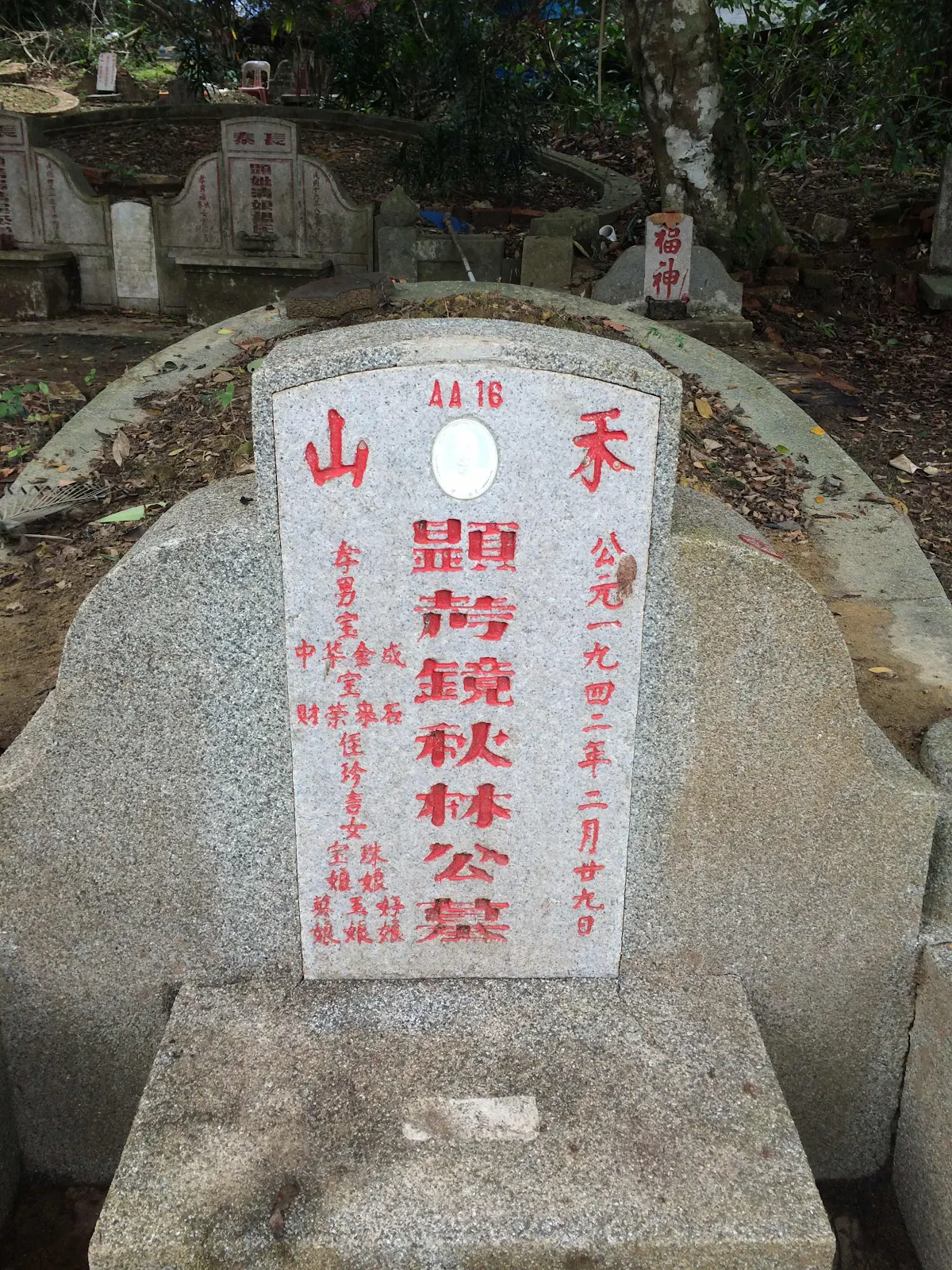
禾山
公元一九四二年二月廿九日 (14 Apr 1942)
顯考鏡秋林公墓
Bukit Brown Burial Record
Lim Keng Siew
Date of Death 15.4.42
Date of Internment 15.4.42
Age 72 years
Bukit Brown Blk 1 C Plot No AA 15
Date of Death 15.4.42
Date of Internment 15.4.42
Age 72 years
Bukit Brown Blk 1 C Plot No AA 15
Nanyang Personalities Biography
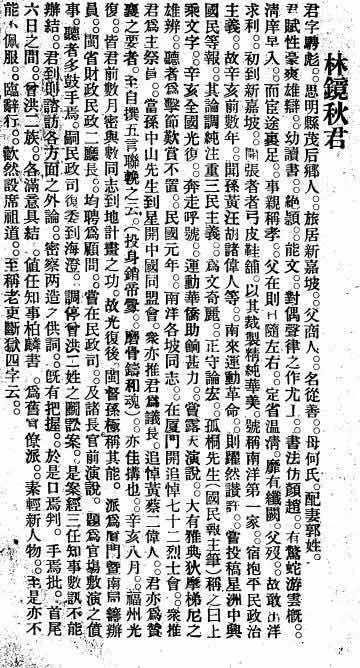
林鏡秋君
君字騁彪。思明縣茂后鄉人。旅居新加坡。父商人。名從善。母何氏。配妻郭姓。君賦性豪爽雄辯。幼讀書。絶頴。能文。對偶聲律之作尤工。書法仿顔趙。有驚蛇游雲概。清庠早入。而宦途裹足。事親稱孝。父在則口隨左右。定省溫清。靡有纖闕。父歿。故敢出洋求利。初到新加坡。開張者者弓皮鞋鋪。以其裁製精純華美。號稱南洋第一家。宿抱平民政治主義。故辛亥前數年。聞孫黃汪胡諸偉人等。南來運動革命。則躍然讚許。嘗投稿星洲中興國民等報。其論調純注重三民主義。為文奇麗。正守論宏。孤桐先生(國民報主筆)稱之曰上乘文字。辛亥全國光復。奔走呼號。運動華僑助餉甚力。賞露天演說。大有雅典狄摩梯尼之雄辨。聽者為擊節歎賞不置。民國元年。南洋各坡同志。在厦門開追悼七十二烈士會。眾亦推君為主祭旨。當孫中山先生到星開中國同盟會。眾亦推君為議長。追悼黃蔡二偉人。君亦為贊襄之要者。至自撰五言聯輓之云。(投身銷帝魯。磨骨鑄和魂)。亦佳構也。辛亥八月。福州光復。皆君前數月密與數同志到地計畫之功。故光復後。閩督孫極稱其能。派為厦門暨南局籌辦員。閩省財政民政二廳長。均聘為顧問。嘗在民政司。及諸長官前演說。以為官場敷演之債事。聽者多鼓手焉。嗣民政司復委到海澄。調停曾洪二姓之闕訟案。是案經三任知事數訊不能辦結。君到則諮訪各方面之外論。密察兩造之供詞。既有把握。於是口焉判。手焉批。首尾六日之間。曾洪二族。各滿意具結。值任知事柏麟書。為舊官僚派。素輕新人物。至是亦不能不佩服。臨辭行。設席祖道。至稱老吏斷獄四字云。
Mr. Lim Keng Chiew
Mr. Lim, also known by his courtesy name Chengbiao, was a native of Maohou Village, Siming County [modern-day Xiamen]. He resided in Singapore. His father, Lim Congshan, was a merchant, and his mother was from the He family. His wife was from the Guo family. By nature, he was heroic, straightforward, and eloquent. In his youth, he was exceptionally brilliant in his studies and excelled in writing, particularly in the art of parallel couplets and tonal meter. His calligraphy followed the styles of Yan Zhenqing and Zhao Mengfu, possessing the spirit of "startled snakes and wandering clouds." He entered the Qing imperial school (Xiucai) early, yet he hesitated to pursue an official career. He was known for his filial piety; while his father was alive, he remained by his side, attending to his needs morning and night without the slightest neglect. Only after his father passed away did he venture overseas to seek his fortune.
Upon first arriving in Singapore, he opened a leather shoe shop. Due to the exquisite and beautiful craftsmanship of his products, it was known as the finest shop in Southeast Asia. He had long held the ideals of populist politics. Thus, several years before the 1911 Revolution (Xinhai Revolution), when he heard that great men like Sun Yat-sen, Huang Xing, Wang Jingwei, and Hu Hanmin were coming south to campaign for the revolution, he leaped with approval. He contributed articles to Singaporean newspapers like the Zhongxing Daily and Guomin Daily. His writings focused purely on the Three Principles of the People; his prose was magnificent and his arguments profound. Mr. Gutong (editor-in-chief of the Guomin Daily) praised his work as "supreme literature."
During the 1911 Revolution, he traveled and campaigned tirelessly, working hard to mobilize overseas Chinese to contribute funds. His open-air speeches displayed a heroic eloquence reminiscent of Demosthenes of Athens, leaving his audience in constant admiration. In the first year of the Republic (1912), when comrades from various Southeast Asian regions held a memorial for the 72 Martyrs in Xiamen, the crowd elected him as the chief officiant. When Dr. Sun Yat-sen arrived in Singapore to establish the Tongmenghui (Chinese Revolutionary Alliance), the members elected Mr. Lim as Chairman. He was also a key organizer in the memorials for the two great men, Huang [Xing] and Cai [E]. The five-character couplet he composed for them—"Casting one's body to dissolve the imperial net; grinding one's bones to forge the soul of peace"—was considered a masterpiece.
The liberation of Fuzhou in the eighth month of the Xinhai year was the result of plans made by Mr. Lim and several comrades who had secretly traveled there months prior. Consequently, after the liberation, Military Governor Sun highly praised his abilities and appointed him as an organizer for the Jinan Bureau in Xiamen. Both the Provincial Departments of Finance and Civil Affairs hired him as a consultant. He once delivered a speech before the Civil Affairs Bureau and various high officials, critiquing the superficiality of officialdom; the audience responded with thunderous applause.
Later, the Civil Affairs Bureau commissioned him to Haicheng to mediate a long-standing legal dispute between the Zeng and Hong clans. This case had remained unresolved despite being tried by three successive magistrates. Upon arrival, Mr. Lim consulted public opinion from all sides and secretly investigated the testimonies of both parties. Once he grasped the truth, he delivered a verbal judgment and signed the decree. Within six days, both the Zeng and Hong clans signed an agreement of satisfaction. The incumbent magistrate, Bo Linshu, who belonged to the old bureaucratic faction and usually looked down upon "new figures," could not help but admire him. Upon Lim's departure, Bo held a farewell banquet and praised him with the words: "A veteran official’s judgment of a case."
Comments
Post a Comment