淸妣太孺人慈熹佘門范氏墓
Madam Wan/Fan , of the Seah household — “The Water Tomb”, MacRitchie
ST0017
Prologue: A Tomb of the Unknown
For decades this was one of MacRitchie’s quiet riddles. In 2003, The New Paper ran a feature by Lee Tee Jong headlined “Tomb of the Unknown” (30 October 2003, p. 11), describing a solitary, throne-like tombstone standing just three steps from the water’s edge along the Chemperai–Jering trail. The carvings were elaborate; the setting, by every geomancer’s reckoning, auspicious — close to nature and facing open water. Joggers who passed it speculated that the deceased had been a nobleman or an official, and most kept a respectful distance, choosing the path further away or passing only behind the stone.
What the paper could establish was slender: a row of red Chinese characters giving a year of death and the surname 'Wan/Fan' (范), the writing already faint and the slabs cracked. Even the National Archives of Singapore had no record of it – their holdings of cemetery and burial records begin only after 1947. Yet someone was clearly still tending it: candles, joss sticks, an urn of spent ash, and a broom resting against a nearby mangrove. The authorities, for their part, had “no intention” of removing it. As one officer put it, unless an exhumation permit were applied for, the stone would stay.
That was the mystery as it stood in 2003. What follows is, in effect, the answer to it — pieced together from a colonial land deed, a newspaper dissolution notice, a boat quay photograph, and a careful re-reading of the old survey maps. The “unknown” of MacRitchie has a name, a family, and a story.
The Tomb
This tomb stands in the MacRitchie catchment, near the Jering Trail. We have long called it the Water Tomb for its setting at the water’s edge. The headstone records a woman of the surname Wan (范) who had married into the Seah (佘) family, together with the names of her three sons.


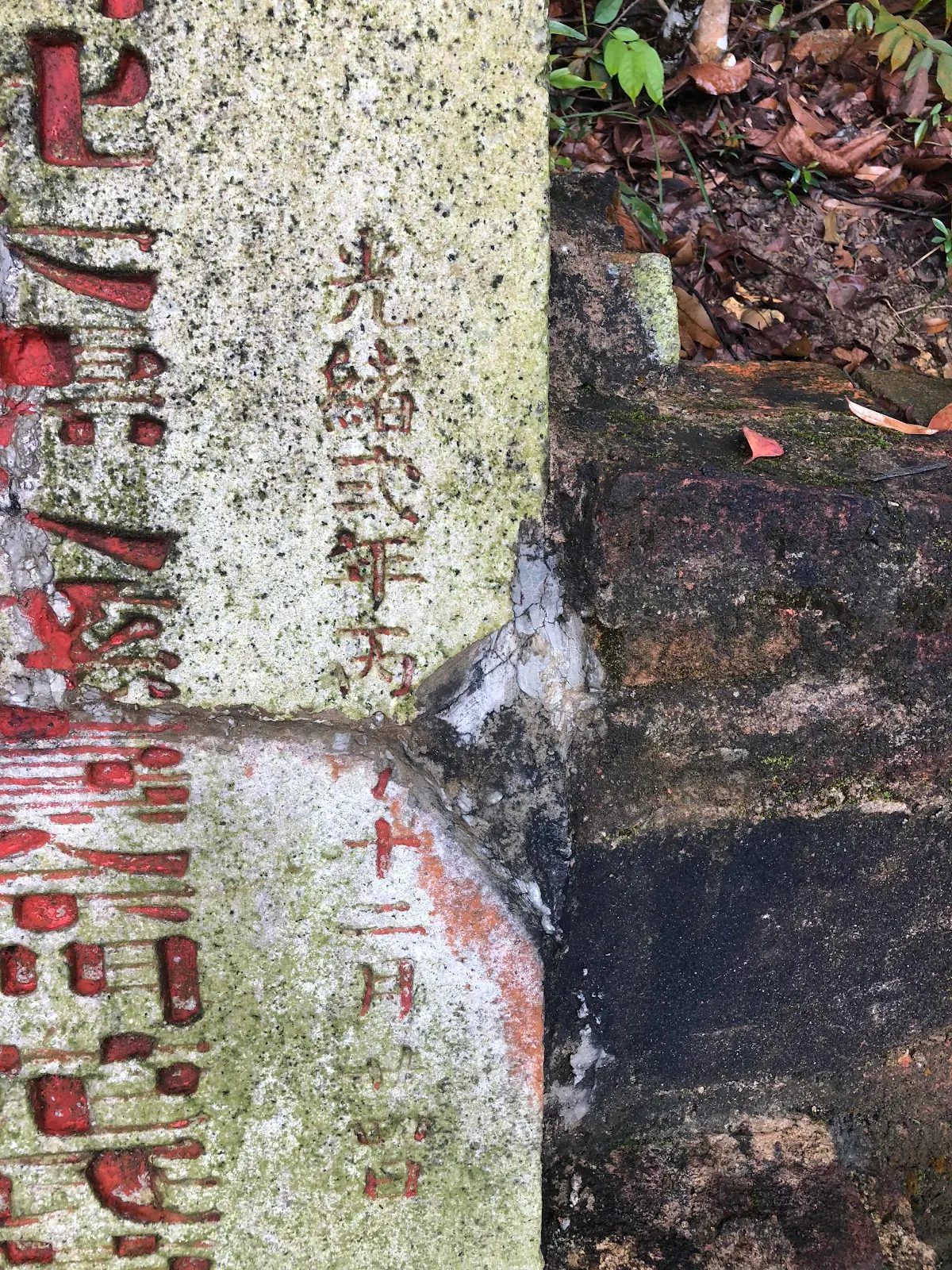


Inscription (as carved)
光緒弍年丙子十二月廿四日
淸妣太孺人慈熹佘門范氏墓
月浦鄉
男 — 福海 仁壽 太和
仝立
Only what is physically visible on the stone is transcribed above. Nothing has been supplied or reconstructed.
Reading the Stone
- Date: 光緒弍年丙子十二月廿四日 — the 24th day of the 12th lunar month, Guangxu 2 (the bingzi 丙子 year). This converts to 6 February 1877 in the Gregorian calendar. Because the date falls in the last lunar month of the year, it sits right at the start of Gregorian 1877 while the stone’s own reckoning remains Guangxu 2.
- The deceased: 淸妣太孺人慈熹佘門范氏 — the late honoured mother, Madam Wan / Fan (范氏), “of the Seah family” (佘門), i.e., a woman of the Wan family who married into the Seah family. 太孺人 is a courtesy honorific for a mother/elder matron and 慈熹 is the posthumous name (maternal kindness and gentleness with warm and brightness).
- Ancestral place: 月浦鄉 — Yue Pu village (Teochew region).
- Sons (男): 福海 (Hok Hai), 仁壽 (Jin Siu), 太和 (Thye Ho) — the three sons who jointly erected the tomb (仝立, “erected together”).
Seah Whye Tek 佘懷德: A Short Biography
Seah Whye Tek (Chinese: 佘懷德; surname 佘 Seah) was a 19th-century Teochew merchant of Singapore and a kangchu (港主, river-master) in Johor. He was a partner in the gambier-and-pepper trade, the commodity economy that underpinned much of Singapore’s and Johor’s 19th-century Chinese commerce.
His principal firm was the shop 振順 “Chin Soon”, a gambier house (甘蜜店) at 120 Boat Quay (formerly No. 117). According to the heritage page maintained by Maidi Lei, Chin Soon was co-founded by 戴河水 (Tek Hoh Swee), 佘懷德 (Seah Whye Tek), 佘德秀 (Seah Tek Sew), 溫振周 (Oon Chin Chew) and the 勝興號 (Seng Heng) firm (巫許亞琰 Boh Koh Ah Tiam). These same names recur in the 1879 deed and in the 1883 dissolution notice, tying the documentary record to a single trading house.

In Johor, Seah Whye Tek and his partner 溫振周 (Oon Chin Chew) were the kangchu of Chew Tek Kang (周德港) — holders of a kangkar (river settlement) concession under the Johor kangchu system, by which the Temenggong/Sultan granted rights to open and manage gambier- and pepper-plantations along a river. This explains the 1879 deed’s reference to firm property held “in Johore” alongside Singapore.
The 1879 conveyance shows him, at that date, assigning his entire business and landed interest to his mother, Sim Ong Neoh, in return for lifetime maintenance — described in the family record as a son entrusting his affairs to his mother. Yet he was still signing as a principal of Chin Soon in 1883, so the 1879 transfer reads more as a protective family settlement than a true exit from the business. The Upper Toa Payoh land he held (Survey Lot 1071) became the setting for the family’s Water Tomb.
The Land: The 1879 Deed
The Water Tomb sits on land tied to a surviving colonial conveyance: Registry of Deeds, Settlement of Singapore, Volume CCXXXVII (237), Page 486, No. 115, dated 17 June 1879. In it, Seah Whye Tek (whose seal reads 佘懷德, surname 佘 Seah, written right-to-left) assigned to his mother, Sim Ong Neoh, his entire interest in three trading firms together with a parcel of land.
The firms named in the deed are the shops “Chin Soon”, “Chew Hang Sang” and “Chew Tek Hang”, with co-partners including Oon Chin Chew. The land is described as the remaining portion of Government Grant No. 19 (dated 26 August 1857), in the district of Upper Toa Payoh, of about 10 acres, 3 roods and 24 poles – corresponding to Survey Lot 1071.
In return, Sim Ong Neoh covenanted to settle her son’s firm debts up to a cap of $1,480, payable to the named shops (Liang Sang $200; Seng Heng $700; Guan Lee $200; Hye Ju Lee $220; Cheng Sang $160), and to pay him $25 a month for life. The deed was witnessed by Tan Heng Jim, clerk to Rodyk & Davidson.
Notes to the Will & Trust Provisions
Beyond the land transfer, the 1879 deed sets out family-trust provisions worth recording, since they illuminate how a 19th-century Teochew merchant family ordered inheritance:
- Lifetime maintenance: $25 per month to Seah Whye Tek, the first payment due 17 July 1879, continuing until his death — or until he became bankrupt or insolvent, at which point the payment was to cease as far as he personally was concerned.
- Redirection to legitimate sons: on such a default, the same $25 monthly sum was instead to be applied, at Sim Ong Neoh’s absolute discretion, to the maintenance of any legitimate son or sons of Seah Whye Tek.
- The “same tribe” condition: any son benefiting had to remain “with the paternal relations on the male side” and not have been adopted by any person “of a different tribe” — an explicit patrilineal safeguard.
- Testamentary trust (2/10 share): Sim Ong Neoh further covenanted to bequeath, by her last will, two-tenths of her residuary real and personal estate in trust — the income to Seah Whye Tek if he survived her (subject to the same bankruptcy proviso) and, on his prior death, by substitution, to his legitimate son(s) in equal shares; failing any male issue, the share fell back into her own estate.
A Corroborating Notice (1883)
A dissolution notice in The Straits Times, 31 March 1883, p. 2, independently attests the chop “Chin Soon” as gambier-and-pepper traders and names Seah Whye Tek among the signatories. It records that the partnership with Oon Chin Chew dissolved on his death, the business continuing at 117 Boat Quay under Hok Swee Tek Sew & Co., chop “Chin Soon". (This is the same premises later renumbered 120 Boat Quay in the photographic record below.) The recurrence of the chop name, the address, and the partners’ names confirms the deed’s readings from independent sources.

Land Ownership: Seah Whye Tek’s Estate
The significance of this tomb lies in whose land it sits on. By the 1879 conveyance, the Upper Toa Payoh parcel — Survey Lot 1071, the remaining portion of Government Grant No. 19 — was Seah Whye Tek’s estate, transferred to his mother Sim Ong Neoh. In the reconstruction worked through by the Goh brothers (Charles and Raymond Goh), the land was very plausibly held as a family burial ground; the Water Tomb stands on its edge.
This land was later compulsorily acquired by the colonial government. The acquisition is itself documented in a surviving record (NAS, “Vol. 246 No. 95”): Government Notification No. 772 of 4 June 1901, published in the Government Gazette of 7 June 1901. It describes “the piece of land situate in the District of Toah Pyoh… Part of Indenture 19 (General No. 1071)… afterwards defined as containing ten acres, three roods and twenty-four poles” — the same parcel as the 1879 deed. The associated government files are cited as Misc. 432/1902, L.O. 448/1901 and Misc. 583/1901.
The Reservoir & the Survival of the Tomb
Singapore’s first impounding reservoir — now MacRitchie — was completed in 1868, predating Madam Wan’s burial. The tomb therefore stood near the water’s edge before the reservoir reached its present extent. The Goh brothers’ reading of the historical maps is that the waterline of the impounded reservoir was, by the time of acquisition, established close to the tomb and that when the surrounding land was taken and the reservoir developed, the burial was deliberately left undisturbed — a rare survival amid the engineering works.
Orientation & Feng Shui
The tomb faces southwest. Standing at the headstone and looking out, the stream lies to the left and to the rear. Before the reservoir, this was a small riverlet rather than the present body of water – a “facing water” setting traditionally regarded as auspicious. The river edge recorded at the time of government acquisition closely matches the present-day outline.
Locating the Tomb: Lot 1071, not 1070
Pinpointing the tomb on historical maps required care. The NUS Libraries Historical Maps of Singapore (LibMaps) georeferenced ca. 1860 overlay appears to need a slight realignment — shifted a little to one side, so that the tomb seems to fall in the adjacent Lot 1070. Re-aligning the old survey against a pre-highway map of the Bukit Brown area brings the marker back inside Lot 1071 – the deed land. On a correctly aligned overlay, the distinctive “V” feature at the bottom of Lease 1071 sits over the tomb; on the slightly shifted overlay it moves off to the right, displacing the site onto 1070.
The practical conclusion: the Water Tomb lies within Survey Lot 1071, confirming that Madam Wan was buried on land that belonged to Seah Whye Tek. (Map research by Charles Goh)


Open Questions
Two points remain unresolved and are flagged rather than assumed:
- Madam Wan’s exact relationship to Seah Whye Tek is not established by either the tombstone or the deed. She married into the Seah family and shares the 月浦 (Yue Pu) ancestral place, but no surviving primary source here states whether she was his wife, mother-in-law, or a collateral relative. The three sons on the stone (福海, 仁壽, 太和) do not appear in the deed.
- The stone’s date converts to Feb 1877, whereas Sim Ong Neoh was a living party to the deed in June 1879; the two women should not be conflated. (The “1876” reported in 2003 and often repeated is the lunar year Guangxu 2 / 丙子, which mostly falls in 1876; the specific day carved on the stone lands on 6 February 1877.)
- Wider clan links (to other prominent Seah lineages) are sometimes suggested but are not documented in the sources cited here and would require clan genealogies or further burial records to substantiate.
Sources
- Tombstone inscription, “Water Tomb”, MacRitchie (near Jering Trail) — field record.
- Lee Tee Jong, “Tomb of the Unknown”, The New Paper, 30 October 2003, p. 11.
- Registry of Deeds, Settlement of Singapore, Vol. CCXXXVII, p. 486, No. 115 (Conveyance, 17 June 1879).
- Government Notification No. 772 of 4 June 1901 (Government Gazette, 7 June 1901); NAS “Vol. 246 No. 95” acquisition record; files Misc. 432/1902, L.O. 448/1901, and Misc. 583/1901.
- NUS Libraries, Historical Maps of Singapore (LibMaps) ca. 1860 overlay — with georeferencing alignment noted.
- MacRitchie (Impounding) Reservoir, completed 1868 — PUB / general history.
- Map and field analysis: the Goh brothers (Charles and Raymond Goh); additional map research assisted by “Mok”.
- The Straits Times, 31 March 1883, p. 2 (dissolution notice, chop “Chin Soon”).
- Maidi Lei, heritage post on 振順號 / Chin Soon at 120 Boat Quay (former No. 117), 27 Aug 2022 — identifying the Chin Soon founders and the Chew Tek Kang 周德港 kangchu connection.
- Lunar-to-Gregorian conversion verified astronomically: Guangxu 2 (丙子), 12th month, 24th day = 6 February 1877.
Research by Raymond and Charles Goh, ongoing