Seah Whye Liang 佘宜光 (d. 1911) and Family
Teochew 潮州 (Region 月浦); headstone dated Xuantong 3 (1911); wife's headstone dated Republic 19 (1930)
Bukit Brown Cemetery, 武吉布朗坟場, Block 3B, plot 396/421 (reserved plot)

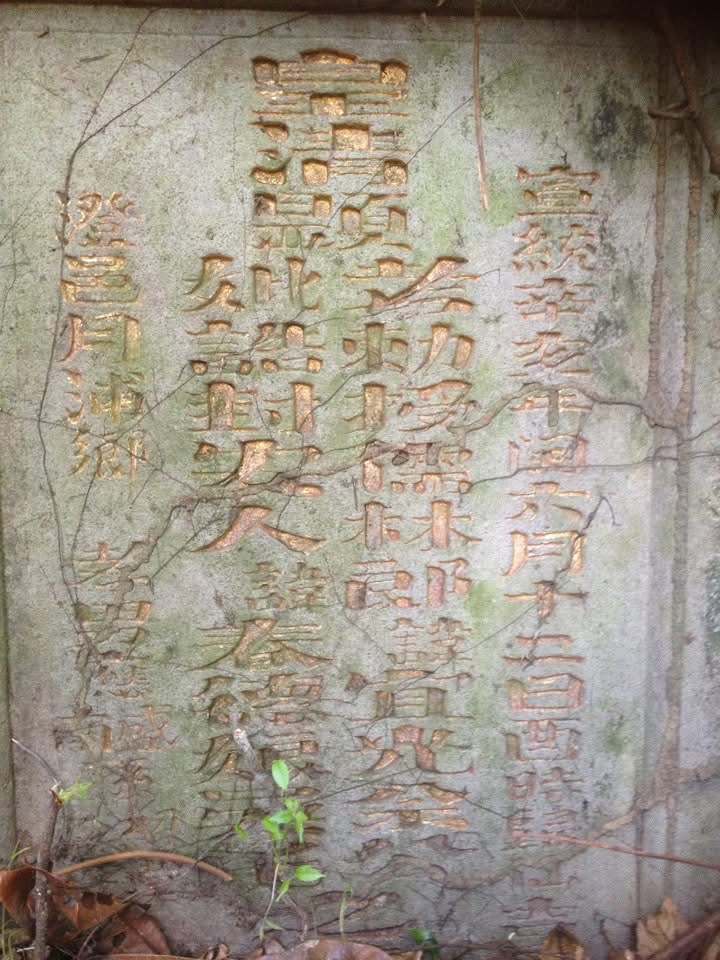


Tomb inscriptions:
Stone 1, Seah Whye Liang (1911):
顯考勅授儒林郎諱宜光佘公
皇清顯妣誥封安人諱春德娘吳氏
宣統辛亥年閏六月十二日酉時歸仙 (6 Aug 1911)
孝男
應盛
應南
紹漢
Stone 2, Goh Choon Kee Neo, headstone of the same plot (1930):
儒門皈依諱
南英陳姑太之墓
民國十九年庚午正月十九日 (17 Feb 1930)
積善堂後學衆等並
佘應盛
佘應南
孫
紹漢
漢山
漢壽
漢保
九仔
美祥仝立
Stone 3, Mrs Seah Eng Nam, nee Yeo Swee Lung (1929):


祖考應南佘
妣瑞蘭楊氏
孝男
美祥
女
碧娥
IN LOVING MEMORY OF MRS SEAH ENG NAM NEE YEO SWEE LUNG DIED 26TH MARCH 1929
Summary: Seah Whye Liang 佘懷亮 died on 6 August 1911 (Xuantong 3, intercalary 6th month, day 12) at No. 14 Mohamed Sultan Road, and his headstone names him as 佘宜光, styled 勅授儒林郎 (a Qing civil honourific title), of Yuepu village in Chenghai county 澄邑月浦鄉, with his wife, titled 安人, 吳氏 春德 (Goh Choon Kee), and two sons, Eng Seng 應盛 and Eng Nam 應南. Beside it stands a second stone, dated 17 February 1930, which is headed 東龍山 (Eastern Dragon Mountain), the name of a Xiantian 先天 vegetarian-hall tradition, and is set up jointly by the disciples of the Chek Sian Tng 積善堂 and by his sons and six grandsons. The date matches the death of Mrs Seah Whye Liang, née Goh Choon Kee, who is recorded in a Malaya Tribune death notice as dying on 17 February 1930 aged 66, which makes her the person behind the stone, although it names a 姑太 (Kor Tai, the highest female rank in the vegetarian halls) under a different name, 陳南英, likely a religious name, although why a different surname is unclear. This is left as a mystery to be solved (see below). An inscription noted on the original post records Seah Whye Liang as a manager and the largest donor of the Eastern Dragon Mountain Tong Sian Tng 同善堂, giving $1,200 in 1898 and $3,000 in 1904. This expanded record adds the inscription tables, the family, a newspaper chronology from 1897 to 1953, and background on the Eastern Dragon Mountain halls from three scholarly and heritage articles.
Key Facts at a Glance
| Name | Seah Whye Liang 佘懷亮 (stone name 佘宜光; also spelt Seah Why Liang) |
| Qing title | 勅授儒林郎 (Ru Lin Lang, a civil honourific of the lower sixth rank) |
| Origin | Yuepu village, Chenghai County (澄邑月浦鄉), Teochew Region |
| Died | 6 August 1911 (Xuantong 3, intercalary 6th month, day 12), 14 Mohamed Sultan Road, Singapore |
| Widow | Goh Choon Kee Neo 吳春德娘 died 17 February 1930, aged 66; named 陳南英姑太 (Kor Tai) on her 1930 headstone. |
| Sons | Seah Eng Seng 佘應盛 and Seah Eng Nam 佘應南 |
| Family tomb | Bukit Brown Cemetery, Block 3B, plot 396 / 421 (reserved plot). The burial register entry is for his widow; his own burial record has not been seen. |
| Religious link | Eastern Dragon Mountain 東龍山 Xiantian vegetarian halls: Tong Sian Tng 同善堂 (donor), Chek Sian Tng 積善堂 (set up the 1930 stone) |
| Open question | Why the widow is 吳 (Goh) on one stone and 陳 (Tan) on the other |
| Last updated | 8 October 2026 |
Tomb Inscription 墓碑銘文
Stone 1: Seah Whye Liang 佘懷亮 and his wife (photographed with the family group)
| 碑文 | Transcription / Meaning |
|---|---|
| 皇清 | "Imperial Qing", heading both columns. Xuantong 3 was the last full year before the dynasty fell in early 1912. |
| 顯考勅授儒林郎諱宜光佘公 | "Revered late father, [by imperial decree] granted the title Ru Lin Lang, personal name (諱) Yiguang, Mr Seah." 勅授儒林郎 is the Qing title. 勅授 means conferred by imperial edict, and 儒林郎 is a civil honourific of the lower sixth rank (從六品) in the Qing system of titles. Titles of this kind were often obtained by overseas merchants through a contribution to the state (捐納), but the stone does not say how he obtained it. The stone names him 宜光, whereas the newspapers and the Tong Sian Tng donation record give 懷亮 (Whye Liang), so the stone appears to carry a formal name. |
| 皇清顯妣誥卦安人諱春德娘吳氏 | "Imperial Qing, revered late mother, 誥封安人, personal name (諱) Chunde, Madam, of the Wu (Goh) family 吳氏." 安人 is the courtesy title of the wife of a sixth-rank official. 誥封安人 ("conferred the title of An Ren by imperial patent"). 吳氏 states her surname as Wu (Goh), and the English notices spell her name Goh Choon Kee, so the third character of 春德 and the English "Kee" are not an exact match. |
| 宣統辛亥年閏六月十二日酉時歸仙 | Right column: "Xuantong, year 辛亥 (xinhai), intercalary 6th month, day 12, at the hour of 酉 (5 to 7 pm), returned to the immortals". '歸仙' is the usual euphemism for 'death'. Converted with an astronomical calendar library, this is 6 August 1911, which agrees with the date of death given in the 1911 estate notice below. |
| 澄邑月浦鄉 | "Chengyi, Yuepu village": 澄邑 is Chenghai county 澄海縣 in the Teochew region, and 月浦 (Yuepu) is the village or township of origin. This is the source of the region label 月浦 on this post. |
| 孝男 應盛 應南 | Filial sons Eng Seng 應盛 and Eng Nam 應南, the two sons named in the 1930 notices. |
| 孫 紹漢 / 珍珠 | Grandchildren named at the foot of the stone: 紹漢 (Shaohan), who is also the first grandson named on Stone 2, and 珍珠 (Zhenzhu, "pearl"), which reads like a personal name. The transcription gives them on separate lines, and the stone does not state their relationship to Eng Seng or Eng Nam. |
Stone 2: the 姑太 stone, 17 February 1930
| 碑文 | Transcription / Meaning |
|---|---|
| 東龍山 | Top, read from right to left, in gilded characters: "Eastern Dragon Mountain". This is the name of the Xiantian vegetarian-hall division described in the background section below. |
| 儒門皈依諱 | "Of the Confucian gate, taken refuge (皈依); personal name (諱) ...". 儒門皈依 is a title of the kind Show Ying Ruo reports on the tomb tablets of the Eastern Dragon Mountain halls, alongside 儒門修道 ("Confucian gate, cultivating the Way"). 諱 introduces the personal name that follows on the next line. |
| 南英陳姑太之墓 | The personal name is 南英 (Lam Eng), rank 姑太, the highest rank held by women in the Xiantian halls, ahead of 老太姑, 大姑 and 姑娘 in the ranking given by Show Ying Ruo. Show notes that names given to the departed in these halls were religious names. See the mystery section below |
| 民國十九年庚午正月十九日 | Right column: "Republic year 19, year 庚午 (gengwu), 1st lunar month, day 19", which is 17 February 1930. |
| 積善堂後學衆等並孝男 佘應盛 佘應南 孫 紹漢 漢山 漢壽 漢保 九仔 美祥仝立 | Left column: "Erected jointly by the later students of the Chek Sian Tng 積善堂 (the disciples of the hall), together with filial sons Seah Eng Seng 佘應盛 and Seah Eng Nam 佘應南, and grandsons 紹漢, 漢山, 漢壽, 漢保, 九仔 and 美祥. "The generation character 漢 (Han) is shared by four of the six grandsons |
Notes on the inscriptions:
- Two different kinds of stone. Stone 1 is a conventional family headstone for a husband and wife. Stone 2 follows the format of the vegetarian halls: the sect name at the top, a religious title and name, and a dedication by the hall's disciples ahead of the family.
- Is Stone 2 for Goh Choon Kee? The date matches exactly: 正月十九日 of Republic Year 19 is 17 February 1930, the day the Malaya Tribune gives for the death of Mrs Seah Whye Liang, and the stone is erected by her two sons. The stone is therefore taken to be hers. The surname difference (陳 on the stone, 吳 on Stone 1) cannot be easily explained even by taking a different religious name and needs further investigation (see "Mystery to be Solved" below).
- Related stone. A third stone photographed with the family belongs to Mrs Seah Eng Nam, née Yeo Swee Lung, who died on 26 March 1929. The base reads "In loving memory of Mrs Seah Eng Nam, née Yeo Swee Lung, died 26th March 1929". The Chinese reads 妣瑞蘭楊氏 ("revered late mother, Swee Lan, of the Yeo family", 楊 being Yeo), with the filial son 美祥 and daughters 碧娥, 碧清 and 碧賢. The name 美祥 also appears among the grandsons on Stone 2, being the son of Eng Nam. The first column reads 祖考應南佘 ("grandfather Eng Nam, Seah"). 祖考 is the Teochew grave style of naming father. Based on the burial register, only the wife is buried here. She is buried in Block 3A, plot 643, not in the Block 3B plot of the 1911 and 1930 stones (see the burial register below).
Burial Register 埋葬記錄
| Name | Goh Choon Kee Neo 吳春德娘 (Mrs Seah Whye Liang) |
| Age | 66 (the Malaya Tribune notice also gives 66) |
| Date interred | 23 February 1930, six days after her death on 17 February 1930 |
| Location | Bukit Brown, Plot 3 B, Plot No. 396 421 (reserved plot) |
Stone 3: Mrs Seah Eng Nam
| Name | Yeo Swee Lung (楊瑞蘭), wife of Seah Eng Nam |
| Age | 35 years |
| Date interred | 28 March 1929 |
| Location | Bukit Brown, Block 3A, plot no. 643 |
The Family 家族
| Person | What the records show |
|---|---|
| Seah Whye Liang 佘懷亮 (tomb name 宜光) | Died 6 August 1911, late of No. 14 Mohamed Sultan Road, intestate. His stone styles him 勅授儒林郎, a Qing civil honourific title, of Yuepu village, Chenghai county 澄邑月浦鄉. He is the manager and largest donor of the Tong Sian Tng, according to the inscription noted on the original post. |
| Goh Choon Kee Neo 吳春德娘 | His widow, styled 安人 on Stone 1 and named 陳南英姑太 on Stone 2 (see "Mystery to be Solved"). Took out Letters of Administration on 28 August 1911 and died 17 February 1930 at No. 226 Orchard Road, aged 66. Her will was proved by her two sons. |
| Seah Eng Seng 佘應盛 | Elder son (the order of the names on the stones). His eldest daughter, Miss Seah Siew Choo, married Mr Sim Kwang Tow at dinner at No. 87 Bukit Timah Road in February 1928. |
| Seah Eng Nam 佘應南 | Younger son. Bought freehold land at Kramat Road for $3,050 in August 1923. His wife, née Yeo Swee Lung (楊瑞蘭), died 26 March 1929 at age 35 and is buried in Block 3A, plot 643. Their children on her stone: 美祥 and daughters 碧娥, 碧清 and 碧賢. |
| Grandchildren: 孫紹漢, 漢山, 漢壽, 漢保, 九仔, 美祥 (Stone 2); 紹漢 and 珍珠 (Stone 1) | Named on the stones. Which of them are sons of Eng Seng and which of Eng Nam is not stated, except that 美祥 (Bee Siang) appears as a son on Mrs Seah Eng Nam's stone. |
| Seah Whye Tong | Named after Seah Whye Liang in the 1908 report on reserved graves. The 懷 (Whye) character is shared with Seah Whye Tek 佘懷德, the Teochew merchant and kangchu on the Water Tomb in MacRitchie post, which suggests but does not show a family link. His relationship to Seah Whye Liang is not stated in any record found. |
Short Biography 生平簡介
Seah Whye Liang appears in the records under spellings including Seah Whye Liang and Seah Why Liang. The 佘 (Seah) surname and his reserved grave in the Teochew burial ground point to a Teochew family, and his stone gives his home as Yuepu village in Chenghai county 澄邑月浦鄉. It also styles him 勅授儒林郎, a Qing civil honourific title of the lower sixth rank, though the stone does not say how he obtained it. The first newspaper mention that may be his is from July 1897, when a Mr Seah Why Liang bought two building lots facing Reserve Road for 22 cents a foot at an auction of 39 lots at Tanjong Pagar Road and five houses at New Bridge Road (Straits Times, 24 Jul 1897). A Mr Seah Whye Liang was also among the saloon passengers who arrived at Penang from Singapore on 9 May 1900 (Pinang Gazette, 10 May 1900). Both entries carry only the name, and nothing in them ties them to the man on the stone.
The stronger evidence is religious and charitable. The note on the original post records that Seah Whye Liang was a trustee (值事人) and the largest donor of the Eastern Dragon Mountain Tong Sian Tng 同善堂, giving $1,200 in the 11th lunar month of Guangxu 24 (1898) and $3,000 in Guangxu 30 (1904). Dean and Hue number the Tong Sian Tng inscriptions 42.01 (1894), 42.02 (1898) and 42.03 (1904) in Chinese Epigraphy in Singapore, 1819–1911, and a 2020 study of sponsors cites these entries (Xu, Dean, Bingenheimer and Bond, 2020). The dates of the 1898 and 1904 gifts match the dates of the second and third inscriptions, but the inscription texts themselves have not been seen for this record, so the gift amounts rest on the note on the original post.
He was one of two men named in a Municipal Commission report in May 1908, when the application of Messrs Seah Whye Tong and Seah Whye Liang to use their reserved graves in the Teochew burial ground was approved, subject to the Governor's sanction (Singapore Free Press, 14 May 1908). He died on 6 August 1911 without leaving a will. On 28 August 1911, letters of administration were granted to his widow, Goh Choon Kee Neo, and a notice placed through Messrs Aitken & Ong Siang of 6 Battery Road called for claims on the estate by 18 November (Straits Times, 26 Oct 1911). Aitken & Ong Siang was the law firm of Song Ong Siang.
His sons carried on the family's religious connection. In August 1923 Seah Eng Nam bought 11,561 square feet of freehold land at Kramat Road for $3,050 at auction (Straits Times, 11 Aug 1923). The Chek Sian Tng was at Kramat Road until it moved to Ang Mo Kio in 1984, and the original post suggests this lot could have been its site. The sale report gives no house number, and the heritage sources give the hall's address as 10 Kramat Road, so the link is a lead to be tested against land records. Eng Seng's eldest daughter, Seah Siew Choo, married Sim Kwang Tow, the honorary general secretary of the Bendemeer Athletic Club, in February 1928 (Malaya Tribune, 27 Feb 1928).
Mrs Seah Whye Liang died on Monday, 17 February 1930, at No. 226 Orchard Road, aged 66, and was buried at Bukit Brown on Sunday, 23 February, at 10 am (Malaya Tribune, 21 Feb 1930). Her son Seah Eng Seng thanked the members of the Jin Wah Kok Association and the Juvenile "Eadmington" Party (probably a badminton group) who attended the funeral (Malaya Tribune, 24 Feb 1930). Her will was proved by Eng Seng and Eng Nam on 11 March 1930, and a notice calling for claims by 26 September 1930 appeared from July (Malaya Tribune, 23 Jul 1930). No. 226 Orchard Road is in the same neighbourhood as Cuppage Road, where the affiliated Sian Teck Tng stands, but nothing seen here shows that she lived or worshipped there.
Background: Eastern Dragon Mountain 東龍山 and the Vegetarian Halls 齋堂
The heading on Stone 2 places the family within a religious tradition that is now better documented than its tombs. The following points come from the three articles used to expand this record.
- Tombs of the halls at Bukit Brown. Show Ying Ruo ("Cultivating the Way in the Eastern Dragon Mountain", NSC Highlights 8, ISEAS Nalanda-Sriwijaya Centre, 2018) reports that the tombs of residents of the vegetarian halls of Eastern Dragon Mountain and of the Mountain of Boundless Longevity have been rediscovered at Bukit Brown and illustrates the article with a photograph of an Eastern Dragon Mountain tomb credited to Raymond Goh. The halls served the Xiantian (Former Heaven) sect, combined residence with worship, and practised celibacy and vegetarianism. They were not organised by dialect or clan, and a large proportion of their members were women.
- Titles and names on the tombs. The tombs carry titles such as "Disciple of Confucius in the Cultivation of the Way" and "Protector of the Way", and the departed are given religious names. In the Eastern Dragon Mountain division, residents' names and hall titles incorporate the character 善 (good). The 善 in 積善堂, 同善堂 and 善德堂 follows that pattern.
- The 姑太 (Kor Tai). The article describes the Kor Tai, the "Greatest Lady", as the highest female rank, and says the abbesses of the Eastern Dragon Mountain halls were often Peranakans, the best known being Song Guat Neo, the widow of Tan Jiak Kam (1865–1889). In the Chinese article, Zai Di Hua De Nu Xing Zong Jiao Kong Jian Yu Xing Bie Shi Jian 〈在地化的女性宗教空間與性別實踐〉 (Chinese Religious Studies 華人宗教研究 no. 11, Jan 2018, pp. 37–100), she lists four ranks for women: 保恩 姑太, 引恩 老太姑, 證恩 大姑 and 天恩 姑娘.
- The Tanglin lineage 東陵門系. The same article traces the Singapore Eastern Dragon Mountain division to 馬純清 (Ma Chunqing, dharma name 道權, from Chaoyang 潮陽), who came by way of Penang and built the men's Tong Sian Tng 同善堂 on Devonshire Road. Its affiliated women's halls were the 善德堂 on Cuppage Road, the 積善堂 on Kramat Road, the 善福堂 and the 善緣堂. The author notes that 東龍 may be an alternative rendering of 東隆 or 東陵. She cites Dean and Hue, Chinese Epigraphy in Singapore, pp. 1237–1238 (Tong Sian Tng), 1240–1241 (the Sian Teck Tng stele, which mentions donors 余雙城 and 文江翁 giving land) and 1247 (a printing block of the Diyu bianxiang tu 《地獄變相圖》 "held by the Eastern Dragon Mountain Tong Sian Tng").
- The women's halls in 2002. Noreen Chan, "Cuppage Road Temple: The Sian Teck Tng Vegetarian Convent", and Tan Geok Koon and Tan Ban Huat, "Devonshire Road Chye Tng" (The Peranakan, Peranakan Association Singapore, Jan–Mar 2002, issue 1, pp. 7–11), describe the Cuppage Road convent as a home for widows and older unmarried women, built on land provided by a Teochew family living next door, with donors recorded on two stone tablets flanking the entrance. They also name the founder as Master Beh Soon Ching, say that he founded the Chek Sian Tng at Kramat Road as well, and note that the Chek Sian Tng was re-sited to Ang Mo Kio Avenue 10 in 1984.
- Later years. Show notes that 30 to 40 of these halls survive in Singapore, most of them branches of the Waterloo Street Guanyin Temple (Hall of Heavenly Virtue, 1884), and that during the Malayan Emergency the halls took in destitute elderly people and children.
Three halls, three founding dates. The sources do not agree on when the halls began, and the table keeps the figures apart.
| Hall | What the sources say |
|---|---|
| Tong Sian Tng 同善堂, Devonshire Road | Founded in 1892, per Show Ying Ruo (2018) and the Asia Research Institute newsletter (Oct 2019). Built in 1894, per the temple's stone tablet, as reported by Roots. sg. "Mid 19th century", per The Peranakan (2002). The donation inscriptions are dated 1894, 1898 and 1904 (Dean and Hue nos. 42.01 to 42.03). |
| Sian Teck Tng, 善德堂, Cuppage Road | Established in 1883, with the stele erected in 1903, per Show Ying Ruo (2018). Built in 1904, per Roots.sg, it says it housed an estimated 40 widows and unmarried women. About a century before 2002, per The Peranakan. |
| Chek Sian Tng 積善堂, Kramat Road, then Ang Mo Kio | "Early 20th century", per the ARI newsletter, which gives its first site as 10 Kramat Road and says it began operating at Ang Mo Kio in 1984 after the Kramat Road land was acquired for the Central Motorway. Roots.sg prints the name as 积德堂, whereas the Stone 2 inscription reads 積善堂. |
Newspaper Record 報章紀錄
| Date / Paper | Summary and link |
|---|---|
| 24 Jul 1897 Straits Times | Auction of 39 lots at Tanjong Pagar Road and five houses at New Bridge Road: Mr Seah Why Liang buys two lots facing Reserve Road at 22 cents a foot. Same name only; identity not confirmed. Read the article. |
| 10 May 1900 Pinang Gazette | Steamer report: Mr Seah Whye Liang is among the saloon passengers who arrived at Penang from Singapore the previous morning. Same name only; identity not confirmed. Read the article. |
| 14 May 1908 Singapore Free Press (Weekly) | Municipal Commission: the application of Messrs Seah Whye Tong and Seah Whye Liang to use their reserved graves in the Teochew burial ground is approved, subject to the Governor's sanction. Read the article. |
| 26 Oct 1911 (repeated to 18 Nov) Straits Times | Notice in the estate of Seah Why Liang, late of No. 14 Mohamed Sultan Road, who died intestate on 6 August 1911. Letters of Administration were granted to Goh Choon Kee Neo on 28 August 1911, and claims were to be sent to Aitken & Ong Siang by 18 November. Read the first notice; read the repeat of 11 Nov. |
| 11 Aug 1923 Straits Times | Property sale: freehold land at Kramat Road, 11,561 sq ft, bought by Mr Seah Eng Nam for $3,050. Read the article; also Malaya Tribune, same date. |
| 27 Feb 1928 Malaya Tribune | Sim-Seah wedding: Mr Sim Kwang Tow, younger son of Mrs and the late Mr Sim Choo Cheng (as spelt on the original post), marries Miss Seah Siew Choo, eldest daughter of Mr and Mrs Seah Eng Seng, with a dinner at No. 87 Bukit Timah Road attended by over 300 guests. Read the article; also, Straits Times, 28 Feb 1928. |
| 21 Feb 1930 Malaya Tribune | Death notice: Mrs Seah Whye Liang, née Goh Choon Kee, mother of Seah Eng Seng and Seah Eng Nam, died on Monday 17 February aged 66. Funeral at 10 am on Sunday, 23 February, at Bukit Brown. Read the article. |
| 24 Feb 1930 Malaya Tribune | Acknowledgement by Mr Seah Eng Seng and family, thanking those who attended the funeral, including members of the Jin Wah Kok Association and the Juvenile "Eadmington" Party, and those who sent wreaths. Read the article. |
| 23 Jul 1930 (repeated to 5 Aug) Malaya Tribune | Notice in the estate of Goh Choon Kee Neo, late of No. 226 Orchard Road, who died on 17 February 1930. Probate was granted to Seah Eng Seng and Seah Eng Nam on 11 March 1930, and claims were to be sent to Aitken & Ong Siang, Bonham Building, by 26 September 1930. Read the first notice; read the repeat of 5 Aug. |
| 26 Mar 1953 Singapore Standard | The Singapore Seah Clan Association elects its 1953 office-bearers; a Seah Eng Nam is named among the vice-presidents. Same name only, and if it were the same man, he would have been well over 50 by then. Read the article. |
Mystery to be Solved: Goh Choon Kee 吳春德 or Tan Lam Eng 陳南英?
The widow of Seah Whye Liang appears under two names that do not share a surname, and the records do not explain it.
What points to one woman?
- The date on Stone 2, 17 February 1930, is the day the Malaya Tribune gives for the death of Mrs Seah Whye Liang, née Goh Choon Kee, aged 66.
- Stone 2 stands in the same plot as her husband's stone and was set up by the same two sons, Eng Seng and Eng Nam, with the grandsons, one of whom, 紹漢, is also named on Stone 1.
What does not fit
- Stone 1 gives her surname as 吳氏 (Goh), and the death notice, the 1911 grant of administration and the 1930 probate notice all call her Goh Choon Kee Neo.
- Stone 2 gives her personal name as 南英 (Lam Eng) and her surname as 陳 (Tan), written before the rank 姑太. Neither the personal name 春德 nor the surname 吳 appears on it.
- Show Ying Ruo's articles explain that the departed are given religious names. That could account for 南英, but the Kor Tai she names are given under an ordinary surname and given name, so a religious name does not obviously explain why the surname changes from 吳 to 陳.
Possible explanations (none yet supported by a record)
- She was born or adopted into a Tan family and later lived as a Goh, so both surnames were hers at different times.
- The hall gave her a religious name that carried a surname of its own, a practice the articles do not describe.
- Two women died on the same day: Mrs Seah (Goh) and a Kor Tai Tan Lam Eng whose stone was placed in the family plot. The shared date, plot and sons make this unlikely
- The stone, or the transcription of its characters, is wrong or incomplete, also unlikely
What could settle it?
- The Bukit Brown burial register for 17 to 23 February 1930, to see whether one entry or two exist and under which names.
- The ancestral tablets of the Chek Sian Tng (now at Ang Mo Kio), which should list its Kor Tai and deceased members.
- Her probate and the Seah family's estate papers, which may give her maiden name and any other name she used.
Frequently Asked Questions
Who was Seah Whye Liang 佘懷亮?
Seah Whye Liang, also written as 佘宜光 on his headstone, was a Teochew man from Yuepu village in Chenghai County who died in Singapore on 6 August 1911. His stone styles him 勅授儒林郎, a Qing honorific title, and he is recorded as a manager and the largest donor of the Eastern Dragon Mountain Tong Sian Tng.
Where is the Seah Whye Liang family tomb?
The tomb is at Bukit Brown Cemetery, Block 3B, plot 396 / 421, recorded in the burial register as a reserved plot. His wife's 1930 headstone stands in the same plot. His daughter-in-law, Mrs Seah Eng Nam, is buried separately in Block 3A, plot 643.
What does '東龍山' on the 1930 headstone mean?
東龍山 means Eastern Dragon Mountain, the name of a division of the Xiantian Dao 先天道 vegetarian halls in Singapore. The stone was set up by disciples of the Chek Sian Tng 積善堂, one of its women's halls, together with her sons and grandchildren.
What is a 姑太 (Kor Tai)?
姑太 is the highest rank open to women in the Xiantian Dao, called 保恩. Below it, in order, are 引恩 (老太姑), 證恩 (大姑) and 天恩 (姑娘), according to Show Ying Ruo.
Are Goh Choon Kee 吳春德 and Tan Lam Eng 陳南英 the same woman?
Probably, but this is unproven. The date of death (17 February 1930), the plot and the sons all match, yet Stone 1 gives her surname as 吳 (Goh), and the 1930 headstone gives 陳 (Tan). The post sets out the possible explanations as a mystery to be solved.
Sources 資料來源
- Original blog post: Seah Whye Liang Family, tombs.bukitbrown.org, 2017 (field photographs, transcription and burial register entry).
- Show Ying Ruo, "Cultivating the Way in the Eastern Dragon Mountain", NSC Highlights 8, ISEAS Nalanda-Sriwijaya Centre, 2018, pp. 5–6. iseas.edu.sg
- 蘇芸若 (Show Ying Ruo), 〈在地化的女性宗教空間與性別實踐—新加坡、馬來西亞先天道齋堂的案例考察〉, 《華人宗教研究》第11期 (Jan 2018), pp. 37–100.
- Noreen Chan, "Cuppage Road Temple: The Sian Teck Tng Vegetarian Convent", and Tan Geok Koon and Tan Ban Huat, "Devonshire Road Chye Tng", The Peranakan (Peranakan Association Singapore), Jan–Mar 2002, issue 1, pp. 7–11.
- Kenneth Dean and Hue Guan Thye, Chinese Epigraphy in Singapore, 1819–1911 (NUS Press, 2017), cited by Show Ying Ruo, pp. 1237–1238, 1240–1241, 1247, 1249. nuspress.nus.edu.sg
- Xu Duoduo, Kenneth Dean, Marcus Bingenheimer and Francis Bond, "Chinese Singaporean Temples: Digital Humanities Approaches to Frequency Lists of Sponsors", Journal of Digital Archives and Digital Humanities 5 (2020). mbingenheimer.net
- Asia Research Institute, ARI News, October 2019, on the Chek Sian Tng. ari.nus.edu.sg
- "Tong Xian Tng Temple" and "Sian Teck Tng", Roots.sg, National Heritage Board. Tong Xian Tng; Sian Teck Tng
- "Song Ong Siang", Singapore Infopedia, National Library Board. nlb.gov.sg
- Newspaper articles as listed above, via NewspaperSG, National Library Board, Singapore.
- Lunar–Gregorian conversion: 17 February 1930 is the 19th day of the 1st lunar month, and 6 August 1911 is the 12th day of the intercalary 6th lunar month, computed with an astronomical calendar library.

About this record. This entry is part of Singapore Tombstones Epigraphic Materials (S.T.E.M.) 新加坡墓碑銘集录, a specialised digital documentation project and archive recording historical tomb inscriptions in Singapore, with a focus on Bukit Brown Cemetery 武吉布朗坟场, the adjoining Hokkien Huay Kuan burial grounds of Lao Sua and Kopi Sua 羔丕山, and other early Chinese burial grounds. Each record transcribes the original Chinese inscription, gives an English translation, cross-checks it against the burial register, and adds a short biography drawn from contemporary newspapers and archival sources.
Cite this entry as:
Raymond Goh. "Seah Whye Liang, 佘宜光, and Family." Singapore Tombstones Epigraphic Materials (S.T.E.M.), tombs.bukitbrown.org, https://tombs.bukitbrown.org/2017/11/seah-whye-liang-family.html. Accessed [date].
Keywords: Seah Whye Liang, Seah Why Liang, 佘懷亮, 佘宜光, Goh Choon Kee, 吳春德, 陳南英, Seah Eng Seng, 佘應盛, Seah Eng Nam, 佘應南, Seah Whye Tong, Seah Whye Tek, Eastern Dragon Mountain, 東龍山, Chek Sian Tng, 積善堂, Tong Sian Tng, 同善堂, Sian Teck Tng, 善德堂, Beh Soon Ching, 馬純清, Kor Tai, 姑太, vegetarian hall, 齋堂, Xiantian, 先天道, Former Heaven, Kramat Road, Cuppage Road, Devonshire Road, Teochew burial ground, Bukit Brown, 勅授儒林郎, Qing title, 澄海, Chenghai, 月浦, Yuepu, Yeo Swee Lung, 楊瑞蘭, Tan Lam Eng, Guangxu, 光緒, Xuantong, 宣統, 民國十九年, 1911, 1930, Chinese tomb inscriptions, Singapore, Singapore Tombstones Epigraphic Materials, S.T.E.M.