STEM Lesson 1 - The Evolution of 國 Country
Tomb Lessons from 20 years of transcribing and researching tombs · Lesson 1Summary: This is the first in a series of STEM Lessons, sharing what has been learned from transcribing and researching tombs for 20 years. Lesson 1 follows the character 國 (country), which reflects 3,000 years of changing ideas of territory, ruler, people and nation. More than 40 historical variants of 國 are recorded in texts and epigraphy. The lesson was prompted by two tombs of 1922 at Lao Sua, where the stone titles write 國 as 囻 on one and 囯 on the other: Wee Ek Poon 黃奕本 and Toh Boon Liang 杜文良.
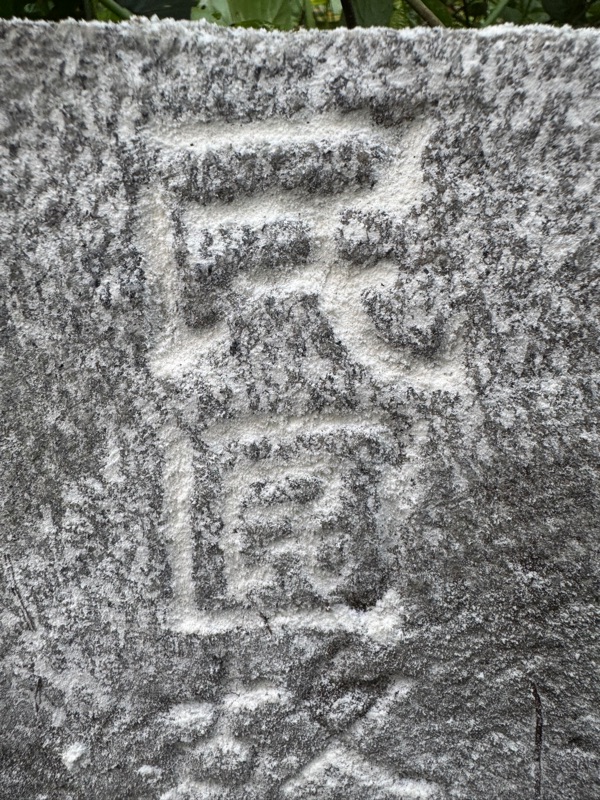
STEM Lesson 1, image 1. Click to enlarge.
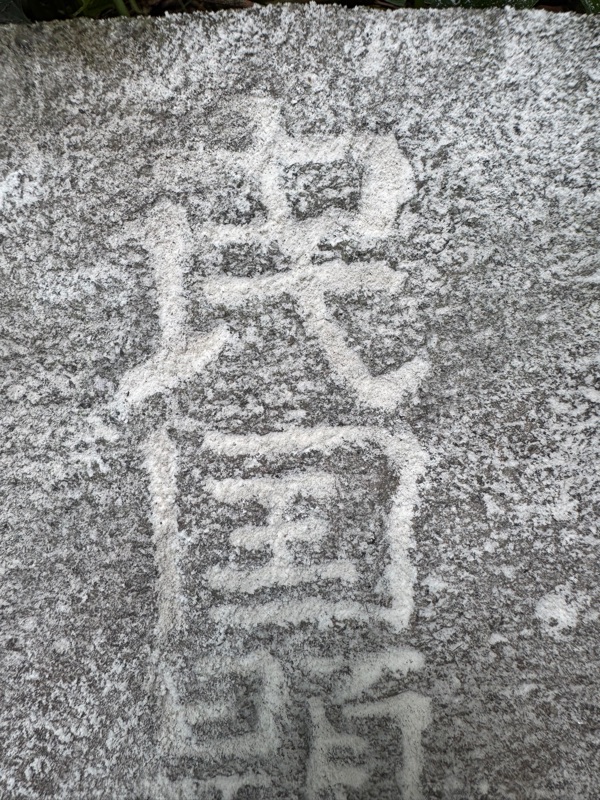
STEM Lesson 1, image 2. Click to enlarge.
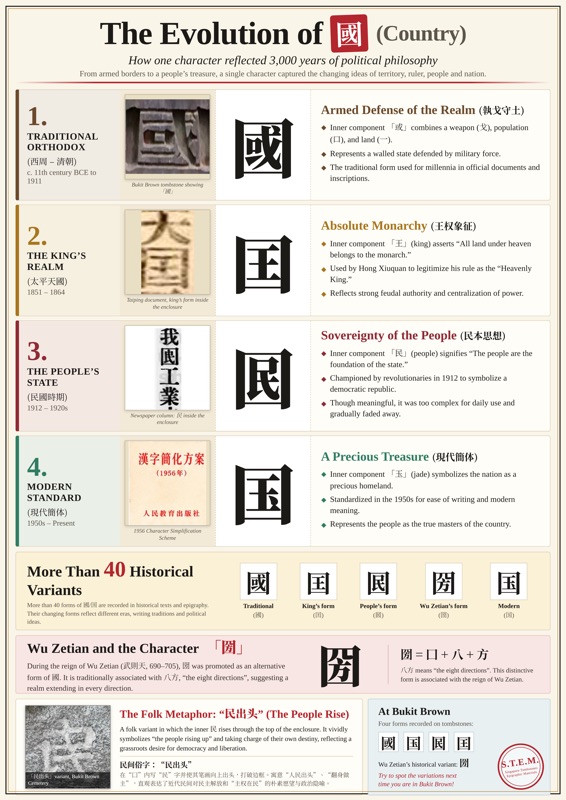
S.T.E.M. infographic: The Evolution of 國 (Country). Click to enlarge.
The four stages 四種字形
| Stage, form and period | Inner component and meaning |
|---|---|
| 1. Traditional Orthodox 西周 – 清朝 國 c. 11th century BCE to 1911 | Armed Defense of the Realm 執戈守土. The inner component 或 combines a weapon (戈), population (口) and land (一). A walled state defended by military force. The traditional form, used for millennia in official documents and inscriptions. |
| 2. The King's Realm 太平天國 囯 1851 – 1864 | Absolute Monarchy 王权象征. The inner component 王 (king) asserts that all land under heaven belongs to the monarch. Used by Hong Xiuquan to legitimise his rule as the "Heavenly King". |
| 3. The People's State 民國時期 囻 1912 – 1920s | Sovereignty of the People 民本思想. The inner component 民 (people) signifies that the people are the foundation of the state. Championed by revolutionaries in 1912 to symbolise a democratic republic. Too complex for daily use, it gradually faded away. |
| 4. Modern Standard 現代簡体 国 1950s – present | A Precious Treasure. The inner component 玉 (jade) symbolises the nation as a precious homeland. Standardised in the 1950s (1956 Character Simplification Scheme). |
Two further variants. 圀 was promoted as an alternative form of 國 during the reign of Wu Zetian 武則天 (690 to 705). It is 口 + 八 + 方, where 八方 means "the eight directions", suggesting a realm extending in every direction. The folk variant 民出头 ("the people rise") has the inner 民 rising through the top of the enclosure, a popular metaphor of the people taking charge of their own destiny. Four forms of 國 are recorded on tombstones at Bukit Brown.
Sources 資料來源
- Tomb inscriptions and photographs by Raymond Goh, Lao Sua and Bukit Brown Cemetery.
- Wee Ek Poon 黃奕本 and Toh Boon Liang 杜文良, S.T.E.M., October 2026.

About this record. This lesson is part of Singapore Tombstones Epigraphic Materials (S.T.E.M.) 新加坡墓碑銘集录, a specialised digital documentation project and archive recording historical tomb inscriptions in Singapore, with a focus on Bukit Brown Cemetery 武吉布朗坟场 and other early Chinese burial grounds. Each record transcribes the original Chinese inscription, gives an English translation, cross-checks it against the burial register, and adds a short biography drawn from contemporary newspapers and archival sources.
Cite this entry as:
Raymond Goh. "STEM Lesson 1 - The Evolution of 國 Country." Singapore Tombstones Epigraphic Materials (S.T.E.M.), tombs.bukitbrown.org, [post URL]. Accessed [date].
Keywords: STEM Lesson, tomb lessons, 國, 囯, 囻, 国, 圀, 民出头, Wu Zetian, Taiping, Hong Xiuquan, variant characters, Chinese character evolution, Chinese tomb inscriptions Singapore, Bukit Brown, Singapore Tombstones Epigraphic Materials, S.T.E.M.
STEM Lesson
Comments
Post a Comment