Song Tian Choe 宋天助 and Sng Seng Neo 孫盛娘
Bukit Brown Cemetery 武吉布朗坟场 · Block 5C · Plots 83 and 94 · Song Tian Choe died 24 September 1941, aged 50 · Sng Seng Neo died 5 November 1942, aged 47
Song Tian Choe 宋天助 was the eldest son of Song Kim Swee, according to family information. NewspaperSG records sometimes spell his name “Song Tian Choc.” He died ten weeks before the Japanese invasion of Malaya; his wife, Sng Seng Neo 孫盛娘, died in the first year of the Occupation. Their three children are recorded on the tombs. Their only son, 源發 Song Guan Huat, was left an orphan at ten and survived the war as a boy soldier in the Imperial Japanese Army. He later became the Revd James (Jimmie) Song, the first Chinese incumbent of a parish in the history of the Church of England.
Tomb photographs 墓照
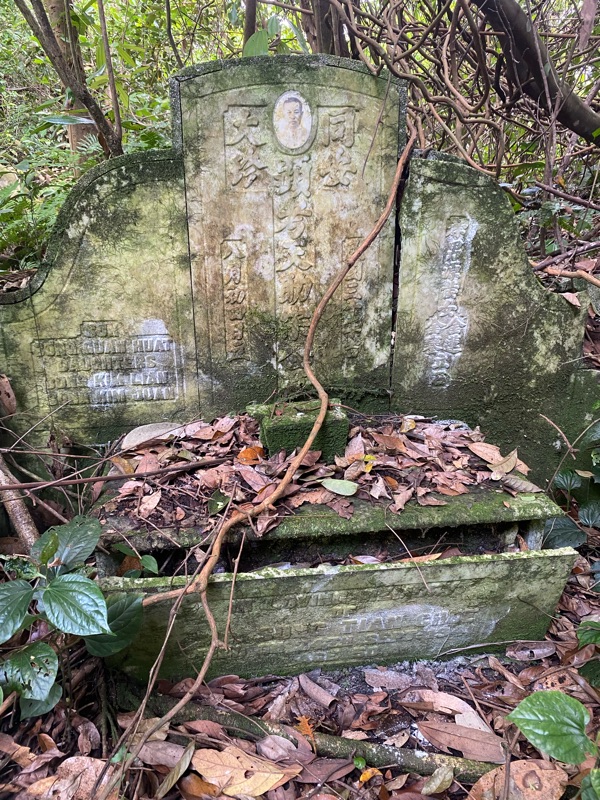
Song Tian Choe’s tomb, Bukit Brown Cemetery, Block 5C, Plot 83. Click to enlarge.
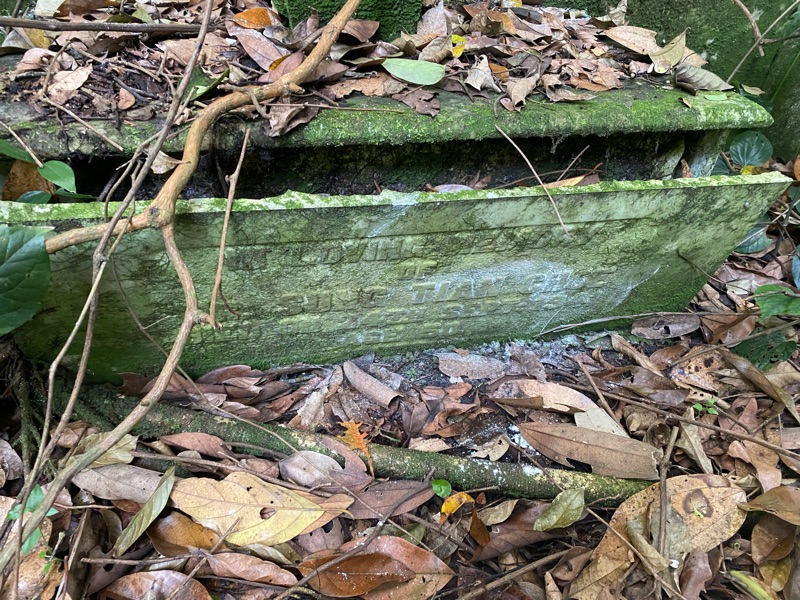
Lower base of Song Tian Choe’s tomb.
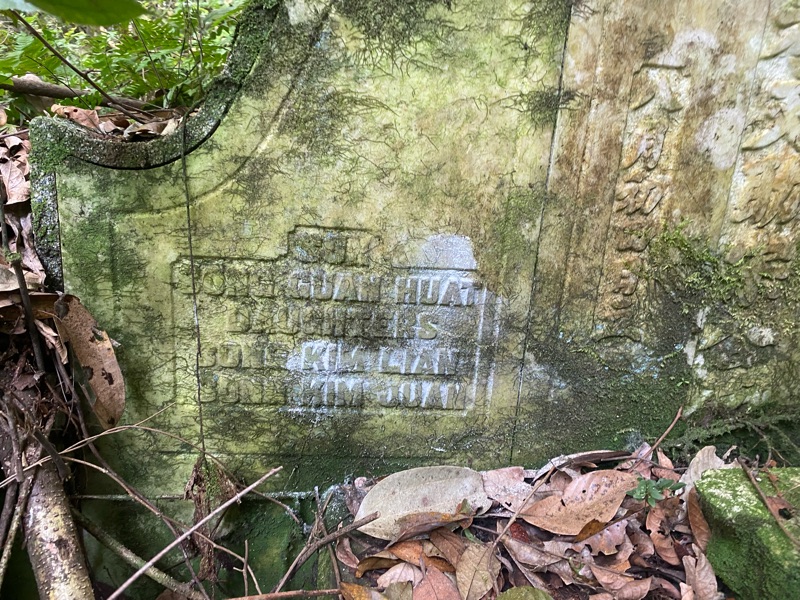
Names of the son and daughters recorded on the tomb.
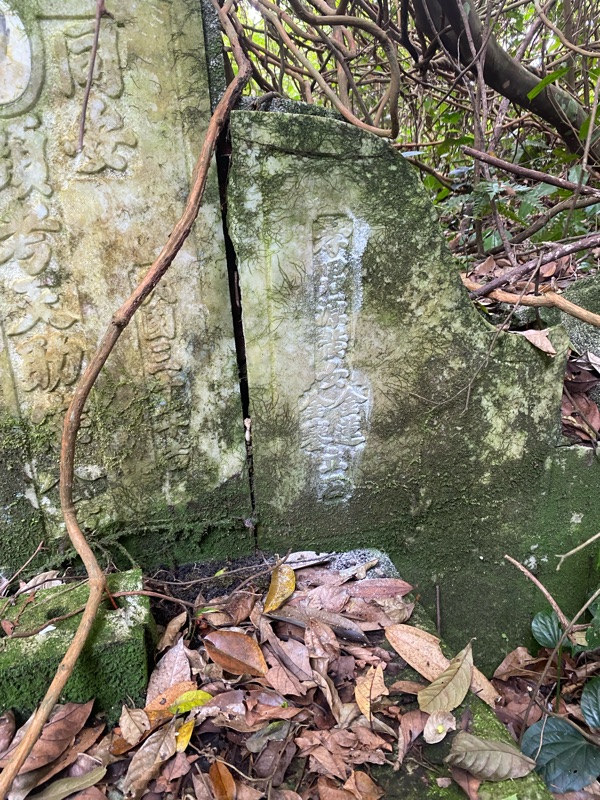
Side inscription on Song Tian Choe’s tomb.
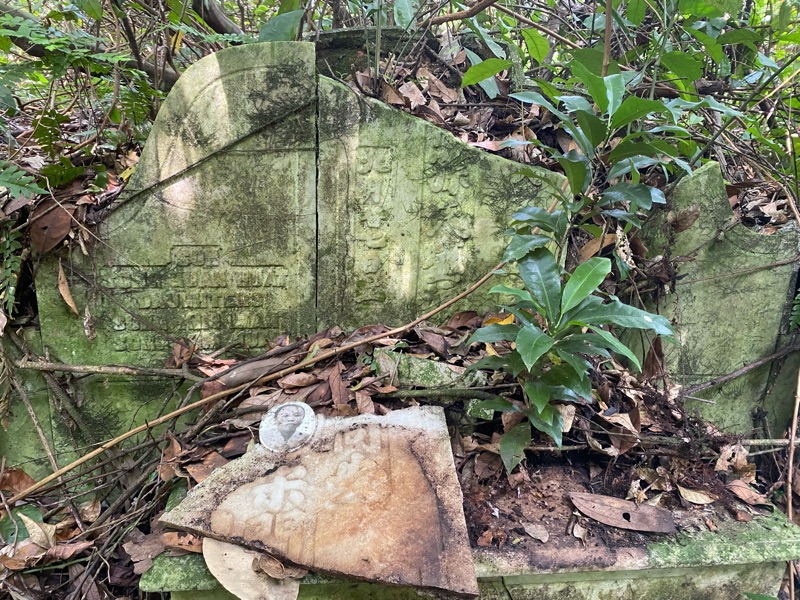
Sng Seng Neo’s tomb, Bukit Brown Cemetery, Block 5C, Plot 94.
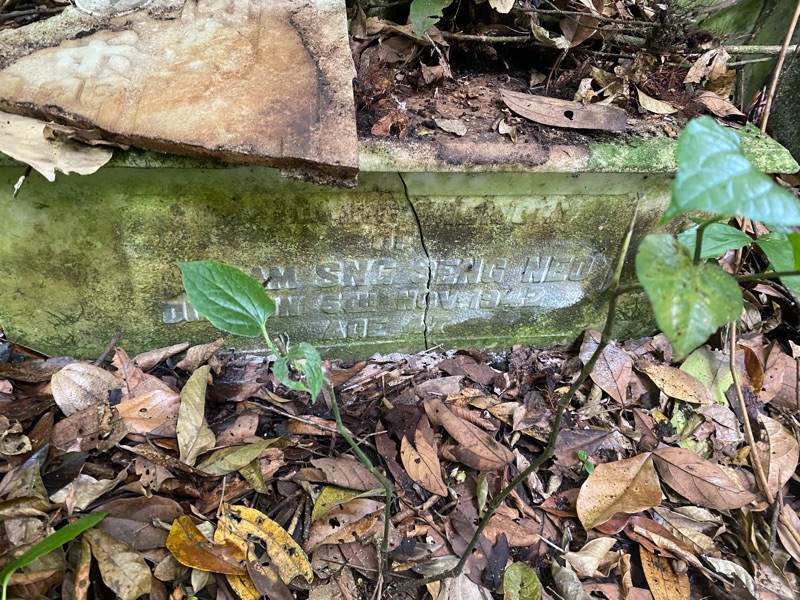
English memorial text on Sng Seng Neo’s tomb.
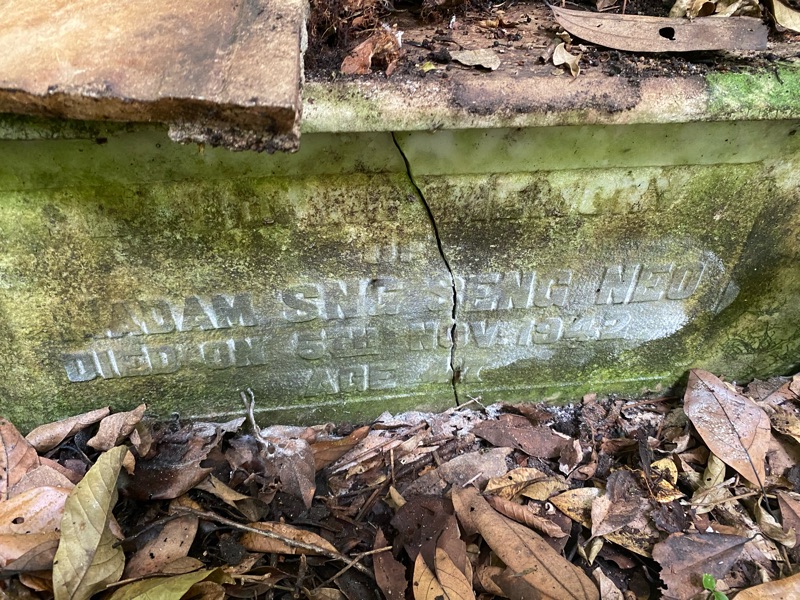
Detail of Sng Seng Neo’s memorial inscription.
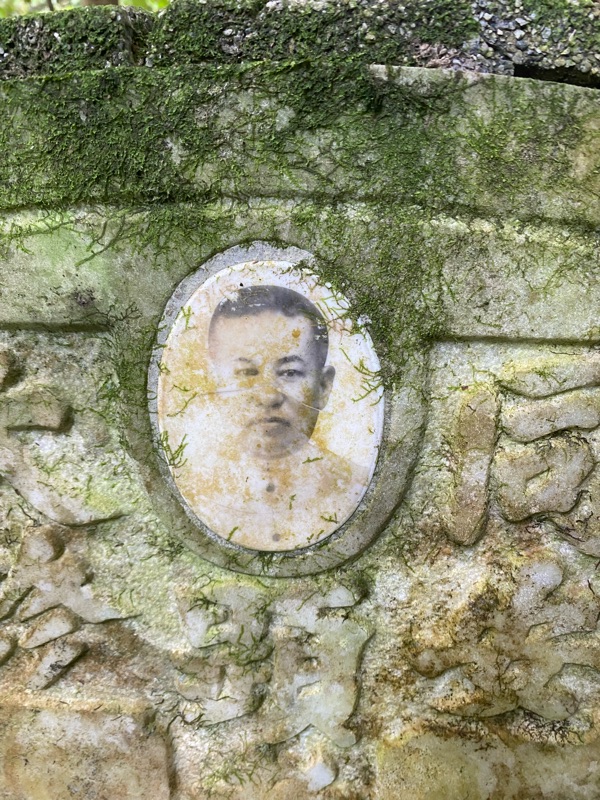
Ceramic portrait medallion on Song Tian Choe’s tomb.
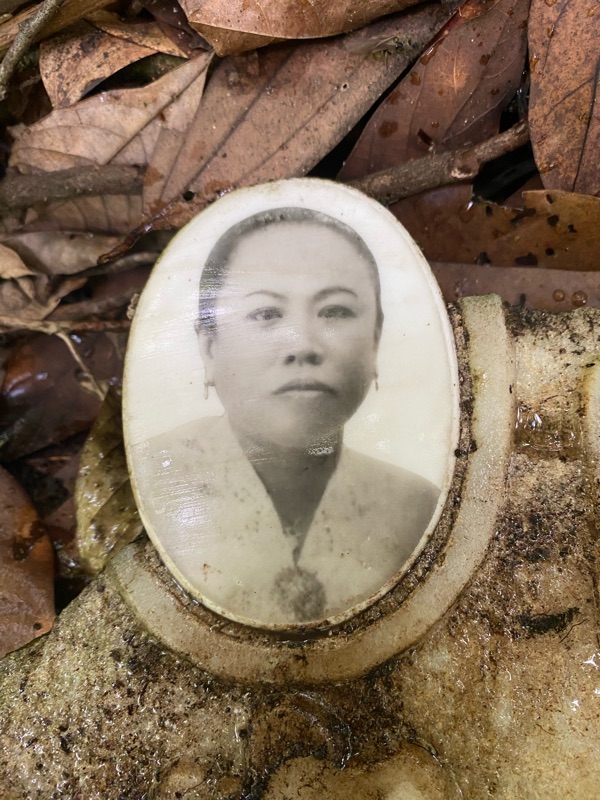
Ceramic portrait medallion associated with Sng Seng Neo’s tomb.
Family 家族
| Relationship | Name | Evidence |
|---|---|---|
| Grandfather | Unnamed; emigrated from Xiamen 廈門 to Singapore around the turn of the twentieth century | Church Times, 8 May 2026; the tomb gives the family origin as 同安大珍 |
| Father | Song Kim Swee | 1927 Straits Times family acknowledgement; family identification |
| Self | Song Tian Choe 宋天助; eldest son; a civil servant | Tomb inscription and family identification; 1927 paper spells his name “Song Tian Choc”; Church Times describes him as a civil servant |
| Wife | Sng Seng Neo 孫盛娘, née Sng | Tomb inscription; 1942 Syonan Shimbun notice identifies “Mrs Song Tian Choe (nee Sng Seng Neo)” |
| Son | 宋源發 Song Guan Huat (1932–2016), baptised James; the Revd Jimmie Song | Tomb inscription; 1959 Straits Times caption names James Song as the son of the late Song Tian Choc; Church Times identifies Song Guan Huat as Jimmie Song’s original Chinese name |
| Daughters | 金蓮 Song Kim Lian (Florence); 金鑾 Song Kim Juan (Molly, d. 1996) | Tomb inscriptions; 1942 notice confirms two daughters; Church Times gives their English names; 1996 Straits Times obituary |
| Daughter-in-law | Shirley Tigg, trainee architect, married James Song in 1959 | 18 December 1959 Straits Times caption; Church Times |
Romanization note: NewspaperSG uses “Song Tian Choc” in the 1927, 1937–38 and 1959 records; the tomb and 1942 death notice use “Song Tian Choe.” The Chinese name on his tomb is 宋天助. The son’s name appears on the family tomb as 源發 / Song Guan Huat; after his baptism in Australia he was known as James, and familiarly as Jimmie (also spelt Jimmy in some accounts). Spellings are retained as each source records them.
Tomb inscription 墓碑銘文
| Inscription | Reading / meaning |
|---|---|
| 同安大珍 | Family origin: Dazhen, Tong’an 同安. The exact locality represented by 大珍 has not been independently identified here. Under the Qing, Xiamen island lay within Tong’an county, so the tomb’s 同安 is consistent with the Church Times statement that the grandfather came from Xiamen. |
| 民國三十年吉 八月初四立 | “Auspicious in the 30th year of the Republic [1941]; erected on the fourth day of the eighth month.” This is the tomb’s erection date, not the date of death. |
| 孝男 源發 | “Filial son: Guan Huat.” |
| 女 金蓮 金鑾 | “Daughters: Kim Lian and Kim Juan.” |
| IN LOVING MEMORY OF SONG TIAN CHOE DIED ON 24TH SEPT 1941 AGE 50 | English memorial inscription for Song Tian Choe. |
| 宋門孫盛娘 | Sng Seng Neo 孫盛娘, who married into the Song family. |
| 九月廿七日 | “Twenty-seventh day of the ninth month,” as inscribed. |
| IN LOVING MEMORY OF SNG SENG NEO DIED 5TH NOV 1942 AGE 47 | English memorial inscription for Sng Seng Neo. |
Burial register 埋葬記錄
| Entry | Song Tian Choe | Sng Seng Neo |
|---|---|---|
| Age | 50 years | 47 years |
| Date of death | 24 September 1941 | 5 November 1942 |
| Date of internment | 28.8.41 as transcribed in the supplied entry; this predates the inscribed death date and needs checking against the original register | 7 November 1942 |
| Location | Bukit Brown Cemetery, Block 5C, Plot 83 | Bukit Brown Cemetery, Block 5C, Plot 94 |
Short biography 生平簡介
Family and names. Song Tian Choe 宋天助 was the eldest son of Song Kim Swee. His father’s family had come to Singapore from Xiamen around 1900; they were Hokkien speakers and devout Buddhists who visited the temple several times a week and offered incense at home daily. The 2 June 1927 Straits Times acknowledgement published in Song Kim Swee’s name lists “Messrs. Song Tian Choc, Teck Hee, Choo Cheng, Teck Chuan and family.” It records Song Tian Choc first among the named sons; the identification as eldest son follows family information, because the notice itself does not use the word “eldest.”
Work and community. The Church Times describes Song Tian Choe as a civil servant. A 28 March 1937 Sunday Tribune report placed the Overseas Telegraph Chinese Staff Association’s fourth annual general meeting at Mr Song Tian Choc’s residence opposite Geylang English School. On 31 March 1938, the Malaya Tribune called him the association’s superintendent. Together these place him in the Chinese staff of the government telegraph service, though the cited items do not give his exact post.
Wife and children. Sng Seng Neo 孫盛娘 bore him a son, Guan Huat, born in 1932, and two daughters, Kim Lian and Kim Juan. The 7 November 1942 Syonan Shimbun notice records the death of “Mrs. Song Tian Choe (nee Sng Seng Neo),” aged 47, leaving one son and two daughters, and announces her funeral from 63 Siang Lim Park to Bukit Brown that day. The Church Times gives the daughters’ English names as Florence and Molly; the 1996 Straits Times obituary names “Mdm. Molly Song Kim Juan.”
The family in the Second World War 戰時家族經歷
The account below draws on Andrew Atherstone’s 8 May 2026 Church Times feature, which is based on Jimmie Song’s unpublished memoir. Where the tombs and contemporary newspapers can test it, they agree with it.
Loss of the father, 1941. Song Tian Choe died of a heart attack in September 1941, aged 50 — the tomb gives 24 September. It was barely ten weeks before the Japanese landings in Malaya and the attack on Pearl Harbor on 8 December 1941 (Singapore time). His tomb, erected in the eighth lunar month of Republic year 30, is among the last family memorials raised before the war reached Singapore. Soon afterwards the family home was destroyed in a Japanese air raid, and on 15 February 1942 the British garrison surrendered.
The Occupation. Guan Huat was nine when Singapore fell. Among his first memories of Japanese rule was being made to watch the public beheading of a Chinese man accused of theft, whose head was then put on show as a warning. He went on to witness torture and executions, men forced to dig their own graves, and bodies drifting in the sea. An uncle and a cousin were taken away by Japanese soldiers and never returned; the Church Times believes they were probably shot. The memoir does not say when or where they were taken. To lessen the danger of rape, his sisters Kim Lian and Kim Juan cut off their hair and passed as boys.
Loss of the mother, 1942. Sng Seng Neo was diabetic, and under the Occupation insulin could no longer be obtained. She died on 5 November 1942, aged 47, and was buried at Bukit Brown two days later, a few plots from her husband. Within fourteen months of his father’s death, ten-year-old Guan Huat was an orphan, without a home and close to starvation in a city where food had all but run out.
Boy soldier and interpreter. With no other means of staying alive, Guan Huat enlisted in the Imperial Japanese Army as a boy soldier. He was put to cleaning aircraft engines from morning to night, paid in a cup of rice, and by his own account tried to sabotage Zero aircraft by slipping sugar into their fuel tanks. Having picked up Japanese quickly, he was taken on as interpreter by a paymaster sergeant, named in the memoir as Tojo, who ran stolen rice and pork onto the black market. Travelling with him, the boy was caught in guerrilla ambushes on jungle roads and fired on at Japanese checkpoints. He later insisted that he had remained a patriotic Chinese throughout, serving the occupiers only to survive. The cost was lasting. As he wrote in his memoir: “I experienced things a child should never have seen which robbed me of my innocence.”
Song Guan Huat 宋源發: from war orphan to the first Chinese incumbent in the Church of England
Raffles Institution and Melbourne. When peace returned, Guan Huat won a place at Raffles Institution. He became a King’s Scout and in 1948 was chosen for the Pan-Pacific Scout Jamboree in Australia. His scoutmaster, Walter Steven, was a British customs officer who had himself been interned by the Japanese at Changi. On hearing the boy’s story, Steven undertook to pay for his further schooling at University High School, Melbourne, where Guan Huat spent the next five years.
Conversion and a new name. At school in Melbourne, fatherless and looking for a model to follow, he was drawn to the life of Edward Wilson, the Antarctic explorer who died with Captain Scott on the return from the South Pole in 1912. Reading George Seaver’s The Faith of Edward Wilson (1948) led him from the Buddhism of his family to Christianity. At his baptism he took the Christian name James, and was known as Jimmie from then on. He later explained that the faith gave him, for the first time, a sense of being loved without condition and of belonging somewhere.
England and ordination. He arrived in London in 1954, aged 22, intending to study medicine, but turned instead towards ministry. He joined the evangelical congregation of St Paul’s, Onslow Square. The London College of Divinity at first declined him until he had more grounding in the faith, so he spent three months with the Lee Abbey community in Devon and a year at All Nations Bible College, Taplow. The College accepted him in 1957, on the understanding that he would go back to serve in South-east Asia; he was among the first Chinese ordinands trained in England. That plan changed when he met Shirley Tigg, a trainee architect, whom he married in 1959.
The Hannibal expedition, 1959. In the summer before his final year of training, James Song was official photographer to the British Alpine Hannibal Expedition, which set out to test how Hannibal crossed the Alps with elephants in 218 BC. The team walked Jumbo, a young Indian elephant borrowed from a Milan zoo, from France into Italy; the Straits Times reported the crossing of the Moncenisio Pass on 30 July 1959, and the venture was profiled in Life magazine. The 18 December 1959 marriage caption calls it the “Oxford University Hannibal expedition,” a 1966 report speaks of Cambridge University students, and both John Hoyte’s St John’s College account and the Church Times describe it as organised by two young Cambridge graduates. This entry therefore does not assign James himself a university affiliation.

The 18 December 1959 caption identifies James Song as the son of the late Song Tian Choc, gives the bride’s surname as Tigg, and names James as the Hannibal expedition photographer. View the full page scan on NewspaperSG.

Jumbo on the Alpine route, 1959. John Hoyte’s St John’s College account names Jimmy Song as expedition photographer; the person shown beside Jumbo is not individually identified in the source. Read the expedition account.
Curacies. After ordination he served as curate at Christ Church, Virginia Water, and then at St Paul’s, Portman Square, in London’s West End, where he was also chaplain to the Selfridges department store.
The first Chinese incumbent, 1966. In 1966, aged 34, James Song was instituted as vicar of Holy Trinity, Matlock Bath, a village parish in Derbyshire. The Church Times of the day announced him as the first Chinese to be appointed incumbent of a parish in England, and his name, “James Song 1966,” stands on the board of incumbents inside the church. The appointment drew curious local press interest in a former Buddhist leading a rural English parish, and some of it betrayed the prejudices of the time. At his induction the Bishop of Derby, Geoffrey Allen, reminded the congregation that Chinese civilisation was far older than Britain’s and that they had much to learn from it. In Singapore, the Straits Times of 19 September 1966 reported the appointment of the boy from Katong, recalling his elephant crossing of the Alps.
Woking and retirement. In 1976 he moved to the much larger evangelical parish of St John’s, Woking, in Surrey, which he led until he retired in 1994. Among his young parishioners in the late 1970s was Sarah Bowser, who came to Christian faith there in 1978 at the age of 16; as Sarah Mullally she is now Archbishop of Canterbury, and it was while writing her biography that Atherstone came upon Song’s story. Parishioners remembered him for a pastoral gentleness rooted in his own suffering, and for his conviction that faith could transform a life.
Last years. The war never fully left him. Near the end of his life, during a short stay in a Surrey care home and a spell of confusion, he took the nurses for Japanese prison guards and rose to declare loudly that he was Chinese, not Japanese. The Revd James Song died in 2016, aged 84. Sixty years after his appointment, clergy of Chinese heritage still make up only about 0.1 per cent of the Church of England’s stipendiary clergy.
From the tomb to the parish. The tomb’s line 孝男 源發 records a ten-year-old boy as chief mourner for a father who died on the eve of war. Read together with his mother’s tomb a few plots away and her 1942 death notice, it is the Singapore beginning of a life that ran from a Buddhist Hokkien household in Katong, through the Occupation as an orphaned boy soldier, to two English parishes and a place in the history of the Church of England.
Chronology 年表
| Date | Event | Source |
|---|---|---|
| c. 1900 | The Song family’s grandfather emigrates from Xiamen to Singapore. | Church Times, 8 May 2026 |
| 2 June 1927 | Family acknowledgement names Song Tian Choc among Song Kim Swee’s sons. | Straits Times; NewspaperSG |
| 1932 | Song Guan Huat is born in Singapore. | Church Times |
| 28 March 1937 | Overseas Telegraph Chinese Staff Association holds its annual meeting at Song Tian Choc’s residence. | Sunday Tribune; NewspaperSG |
| 31 March 1938 | The association’s fifth-anniversary dinner is held at the residence of its superintendent, Mr Song Tian Choc. | Malaya Tribune; NewspaperSG |
| 24 September 1941 | Song Tian Choe dies of a heart attack, aged 50. | Tomb inscription; Church Times |
| 8 December 1941 | Japanese forces land in Malaya and attack Pearl Harbor. The Song home is later destroyed in an air raid. | Church Times |
| 15 February 1942 | Singapore surrenders. Guan Huat witnesses public executions; an uncle and a cousin disappear; his sisters disguise themselves as boys. | Church Times |
| 5 November 1942 | Sng Seng Neo dies, aged 47, without access to insulin; buried at Bukit Brown on 7 November. | Tomb inscription; Syonan Shimbun; Church Times |
| 1942–1945 | Guan Huat, orphaned at ten, serves in the Imperial Japanese Army as a boy soldier and later as an interpreter. | Church Times |
| 1948 | As a King’s Scout from Raffles Institution, attends the Pan-Pacific Scout Jamboree in Australia; his scoutmaster Walter Steven funds his schooling at University High School, Melbourne. | Church Times |
| Melbourne years | Converts to Christianity and is baptised James. | Church Times |
| 1954 | Arrives in London, aged 22. | Church Times |
| 1957 | Accepted for ordination training at the London College of Divinity. | Church Times |
| 30 July 1959 | James Song and Jumbo cross from France into Italy through the Moncenisio Pass. | Straits Times; NewspaperSG |
| 18 December 1959 | Marriage caption identifies James Song as the son of the late Song Tian Choc and reports his marriage to Shirley Tigg. | Straits Times; NewspaperSG |
| Early 1960s | Curacies at Christ Church, Virginia Water, and St Paul’s, Portman Square (chaplain to Selfridges). | Church Times |
| 1966 | Becomes vicar of Holy Trinity, Matlock Bath, Derbyshire: the first Chinese incumbent of a Church of England parish. | Church Times; Holy Trinity incumbents’ board |
| 19 September 1966 | Singapore report on Rev. James Song recounts the elephant crossing. | Straits Times; NewspaperSG |
| 1976 | Becomes vicar of St John’s, Woking, Surrey. | Church Times |
| 1978 | Sarah Bowser (now Sarah Mullally, Archbishop of Canterbury) comes to faith at St John’s, aged 16. | Church Times |
| 1994 | James Song retires. | Church Times |
| 6 October 1996 | Mdm. Molly Song Kim Juan dies, aged 60; an obituary appears two days later. | Straits Times; NewspaperSG |
| 2016 | The Revd James (Jimmie) Song dies, aged 84. | Church Times |
| 8 May 2026 | Andrew Atherstone’s Church Times feature tells his story and identifies Song Guan Huat as his original name. | Church Times |
Frequently asked questions
Who was Song Tian Choe?
Song Tian Choe 宋天助 (d. 1941) was the eldest son of Song Kim Swee, a civil servant and superintendent of the Overseas Telegraph Chinese Staff Association, buried at Bukit Brown, Block 5C, Plot 83. NewspaperSG sometimes spells his name “Song Tian Choc.”
Who was Sng Seng Neo?
Sng Seng Neo 孫盛娘 (d. 1942) was his wife, buried at Block 5C, Plot 94. She died during the Japanese Occupation, unable to obtain insulin for her diabetes, leaving one son and two daughters.
Who was Song Guan Huat?
Song Guan Huat 宋源發 (1932–2016) was their son, named on the tomb as 孝男 源發. Orphaned at ten, he survived the Occupation as a boy soldier, was educated at Raffles Institution and in Melbourne, was baptised James, and became the Revd Jimmie Song.
Who was the first Chinese incumbent in the Church of England?
The Revd James (Jimmie) Song, born Song Guan Huat in Singapore, became vicar of Holy Trinity, Matlock Bath, Derbyshire, in 1966, and was announced at the time as the first Chinese to be appointed incumbent of a parish in England. He was later vicar of St John’s, Woking, from 1976 to 1994.
How did Guan Huat survive the war?
After both parents died and the family home was destroyed, he joined the Imperial Japanese Army as a boy soldier, cleaning aircraft engines for a ration of rice, and later served a Japanese paymaster as interpreter.
Where are the tombs?
Bukit Brown Cemetery, Block 5C: Song Tian Choe at Plot 83 and Sng Seng Neo at Plot 94.
Sources 資料來源
- Tomb inscriptions, burial-entry transcription and photographs for Bukit Brown Cemetery, Block 5C, Plots 83 and 94.
- “Acknowledgment,” The Straits Times, 2 June 1927. Family notice listing Song Tian Choc among Song Kim Swee’s sons.
- “Annual Meeting,” The Sunday Tribune, 28 March 1937. Overseas Telegraph Chinese Staff Association meeting at Song Tian Choc’s residence.
- “Chinese Telegraphists,” Malaya Tribune, 31 March 1938. Identifies Song Tian Choc as the association’s superintendent.
- Family death notice, The Syonan Shimbun, 7 November 1942. Notice for Mrs Song Tian Choe née Sng Seng Neo.
- “James and Jumbo Cross Alps into Italy,” The Straits Times, 30 July 1959.
- Page 18, The Straits Times, 18 December 1959. Marriage photograph and caption naming James Song as the son of the late Song Tian Choc.
- “The first Chinese to be in charge of an English parish,” The Straits Times, 19 September 1966.
- “850 Deaths,” The Straits Times, 8 October 1996. Obituary naming Mdm. Molly Song Kim Juan.
- Andrew Atherstone, “The extraordinary journey of the first Chinese incumbent in Church of England history,” Church Times, 8 May 2026. Principal source for the family’s wartime experience and James Song’s later life, drawing on his unpublished memoir.
- John Hoyte, “The British Alpine Hannibal Expedition,” Johnian, St John’s College, Cambridge. Names Jimmy Song as expedition photographer.
- Holy Trinity Church, Matlock Bath: memorial inscriptions in the church, Andrews Genealogy. Records the incumbents’ board entry “James Song 1966.”

About this record. This entry is part of Singapore Tombstones Epigraphic Materials (S.T.E.M.) 新加坡墓碑銘集录, a digital documentation project recording historical tomb inscriptions in Singapore. S.T.E.M. entries transcribe inscriptions and, where available, compare them with burial records and contemporary sources.
Research note. The wartime account and James Song’s later career are taken from the Church Times feature, which draws on his unpublished memoir. The tombs and the 1942 death notice independently confirm the parents’ dates and ages and the one-son, two-daughter family; the 1959 and 1966 Straits Times items confirm the link between James Song and Song Tian Choc, the Alpine crossing and the English parish; the Matlock Bath incumbents’ board confirms the 1966 appointment. The memoir-based details of the Occupation (the executions, the disappearances, the disguise, army service) rest on that single source. University attributions for the Hannibal expedition differ between sources and are not harmonised here. The transcribed internment date 28.8.41 predates Song Tian Choe’s inscribed death date 24.9.41 and should be checked against the original register.
Cite this entry as:
Raymond Goh. “Song Tian Choe 宋天助 and Sng Seng Neo 孫盛娘.” Singapore Tombstones Epigraphic Materials (S.T.E.M.), tombs.bukitbrown.org. Accessed [date].
Keywords: Song Tian Choe, 宋天助, Song Tian Choc, Song Kim Swee, Sng Seng Neo, 孫盛娘, Song Guan Huat, 宋源發, 源發, James Song, Jimmie Song, Revd Jimmie Song, first Chinese incumbent Church of England, Holy Trinity Matlock Bath, St John’s Woking, Sarah Mullally, Raffles Institution, King’s Scout, Pan-Pacific Scout Jamboree 1948, Walter Steven, University High School Melbourne, Edward Wilson, London College of Divinity, Song Kim Lian, Florence Song, Song Kim Juan, Molly Song, Japanese Occupation of Singapore, war orphan, boy soldier, Imperial Japanese Army, Hannibal expedition, Jumbo elephant, Tong’an 同安, Xiamen 廈門, Bukit Brown Cemetery, 武吉布朗坟场, Block 5C, Overseas Telegraph Chinese Staff Association, Singapore tomb inscriptions, S.T.E.M.
Bukit Brown Block 5C · Family – Song Kim Swee · Name – Song 宋 · Name – Sng 孫
Comments
Post a Comment