Ang Chong Beng 汪昌明, 同安英村 Ying Village, Tong'an, died 13 October 1921
汪昌明 Ang Chong Beng; died 13 October 1921; tomb erected by the friends of 八仙閣 Pat Sian Kok, Singapore 星嘉坡
Ancestral place 同安英村 Ying Village, Tong'an · Republic-era tomb in Singapore
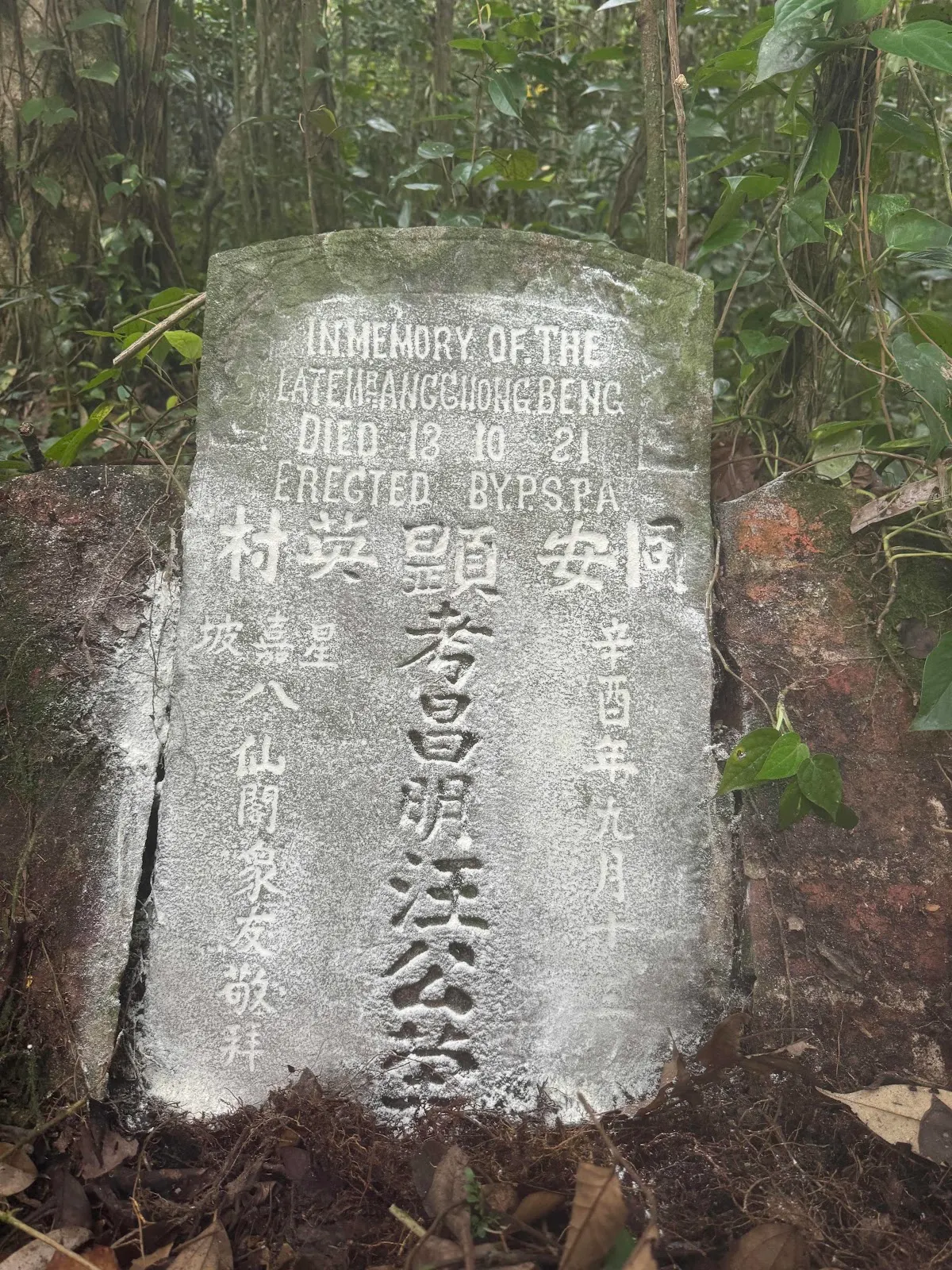
Tomb of Ang Chong Beng 汪昌明. Photograph: Raymond Goh.
Location in Lao Sua, Temple Hill, opp Avatar Trees
Summary: Ang Chong Beng 汪昌明 died on 13 October 1921. The English line on his tomb gives the date as 13.10.21, and the Chinese date 辛酉年九月十三 (the 13th day of the 9th lunar month of the xinyou year) converts to the same day, so the carved date is his date of death. The stone was set up by 星嘉坡八仙閣衆友, the friends of the Pat Sian Kok (Pavilion of the Eight Immortals) in Singapore, and records his family's ancestral home as 同安英村, Ying Village in Tong'an. That village is almost certainly the Ying Village now in Houxi town, Jimei district, Xiamen, which belonged to Tong'an county until the 1950s and is the home village of a well-known group of Ang 汪 families in Singapore. The stone names no wife, sons or other relatives, and the 八仙閣 has not yet been identified in other sources. A man of exactly the same name sat on the committee of the Chinese Fraternal Union in 1920 and was its superintendent in 1921, less than three months before this date of death; the match is by name only and is treated here as a lead and not as a proven identification.
Tomb Inscription 墓碑銘文
| 碑文 | Transcription / Meaning |
|---|---|
| IN MEMORY OF THE LATE ANG CHONG BENG DIED 13 10 21 ERECTED BY P.S.P.A | English inscription. The date is read as day, month, year: 13 October 1921. The initials P.S.P.A. are not expanded on the stone; they fit the 八仙閣 named in the Chinese text below (Pat Sian ...), and the original post suggested "Pat Sian Pavilion Association" with a question mark. |
| 同安英村 | Top. The family's ancestral place 籍貫: Ying Village 英村, Tong'an 同安. The place name records where the family came from and does not mean that he was born there. |
| 顯考昌明汪公塋 | Centre. "The tomb of the late Mr Ang (汪) Chong Beng (昌明)." 塋 means a grave. 顯考 is a respectful formula for a deceased father or forebear, and is normally used by his own descendants; here it is used on a stone erected by friends, and no sons are named. |
| 辛酉年九月十三 | Right. "Xinyou year, 9th lunar month, 13th day". The xinyou year is 1921, and the 13th day of the 9th lunar month of 1921 falls on 13 October 1921 (computed with an astronomical calendar library). This agrees with the English line. |
| 星嘉坡 八仙閣衆友敬拜 | Left. "Respectfully paid by the assembled friends of the 八仙閣, Singapore." 星嘉坡 is an older transliteration of Singapore. 八仙閣 means the Pavilion (or Hall) of the Eight Immortals; its Hokkien reading is Pat Sian Kok. 衆友 means the assembled friends or members. |
Surname and name. The surname 汪 is romanised Ang in Hokkien-speaking Singapore (see Ang (surname), Wikipedia). The given name 昌明 reads Chong Beng, matching the English line.
Ancestral Home: Ying Village, Tong'an 同安英村
同安 was a large county on the Fujian coast around Xiamen Bay. Jimei, to the north of Xiamen island, belonged to Tong'an for most of its history, and Houxi 後溪 was part of the county's third district in 1952 (Jimei district, Chinese Wikipedia; Baidu Baike). Ying Village 英村 is today a community in Houxi town, Jimei district, Xiamen, with a population of about 3,200, roughly half of them surnamed Ang 汪.
A 2023 article in the Jimei newspaper, reproduced by Southeast Net (東南網), tells the history of these Ang families. According to it, the Ying Village Ang founder moved from Hui'an in the Ming period to the foot of Tianma Mountain, and his descendants divided into three branches. Most of the third branch went overseas, mainly to the Malay Peninsula and Luzon, which would fit an Ang from Ying Village living in Singapore in 1921. After the Japanese landing at Xiamen in May 1938, Ying Village Ang families in Singapore founded the 平陽堂, registered in 1939 as the 平陽汪氏公會 and renamed the 新加坡汪氏總會 (Ang Association, Singapore) in 2007. The Singapore Federation of Chinese Clan Associations also lists the 汪氏總會 as established in 1939 (SFCCA directory; NUS index of clan associations).
The match between the tomb and this community is likely, because it rests on the surname 汪, the county 同安 and the village name 英村 together. Because the clan association was founded in 1939, it did not exist when this tomb was erected in 1921, and the stone was raised by his friends of the 八仙閣 and not by a clan body.
Short Biography 生平簡介
What the tomb tells us. Ang Chong Beng 汪昌明 died on 13 October 1921. His family came from Ying Village in Tong'an. His friends in Singapore, grouped under the name 八仙閣, put up the stone and honoured him with the formula 顯考, which suggests a close relationship, though the stone does not explain it. No wife, children or siblings are named. His age at death is not recorded.
The 八仙閣. Searches of NewspaperSG for Pat Sian Kok, Pat Sian Pavilion and related spellings found no society or association of this name. The Eight Immortals (八仙) are a well-known group in Chinese popular religion, so the 八仙閣 may have been a temple, a devotional or social club, or a guild of some kind, and the name may also have been spelt differently in the English-language press. This remains an open question for Singapore Chinese-language newspapers and society records.
A possible newspaper trace (lead only). A man called Ang Chong Beng appears three times in the Straits Times in 1920 and 1921 in connection with the Chinese Fraternal Union, a society registered in 1919 whose aim, as reported, was to aid its members in moral, physical and intellectual uplift, and which met at a club house at 16 River Valley Road. On 30 July 1920 he is listed among the five committee members of the third term. On 11 January 1921 he is superintendent, and on 19 July 1921 he is re-elected as honorary superintendent for the second half of the year. The last of these notices is less than three months before the date on the tomb. The spelling is identical, but the notices give no Chinese name, age, home place or link to the 八仙閣, and the name may not have been unusual. They are cited as a lead to be tested and not as proof that this is the same man.
Newspaper Record 報章記載
| Date | Newspaper and summary |
|---|---|
| 8 October 1919 | Malaya Tribune, "Chinese Fraternal Union". Background to the society: registered under the Societies Ordinance with the object of aiding its members in moral, physical and intellectual uplift; the first committee is listed. Ang Chong Beng is not named in this notice. |
| 30 July 1920 | The Straits Times, Chinese Fraternal Union office-bearers. Office-bearers for the third term ending 31 December 1920 were registered the previous Wednesday; the committee includes Seah Kwang Jim, Tan Keok Thiam, Chua Kim Seng, Lee Hwee Kwang and Ang Chong Beng. |
| 11 January 1921 | The Straits Times, Chinese Fraternal Union general meeting. At the meeting of 2 January at the club house, 16 River Valley Road, the office-bearers for the first half of 1921 were elected; Ang Chong Beng is superintendent. |
| 19 July 1921 | The Straits Times, Chinese Fraternal Union general meeting. At the meeting of 3 July the office-bearers for the second half-year were elected; Mr Ang Chong Beng is honorary superintendent. |
Frequently Asked Questions
Who was Ang Chong Beng 汪昌明?
He was a man of the Ang 汪 surname whose family came from Ying Village in Tong'an, Fujian, who died in Singapore on 13 October 1921. His tomb was erected by the friends of the 八仙閣. Little else is recorded.
When did he die?
On 13 October 1921. The English inscription reads 13 10 21, and the Chinese date 辛酉年九月十三 converts to the same day.
Where was his ancestral home?
同安英村, Ying Village in Tong'an county, which is probably the present Ying Village in Houxi town, Jimei district, Xiamen. An ancestral place on a tomb records family origin and does not state where the person was born.
Who put up the tomb?
星嘉坡八仙閣衆友, the assembled friends of the 八仙閣 in Singapore, who are shown in English as P.S.P.A. The society has not yet been identified in other sources.
Sources 資料來源
- Tomb inscription and photograph supplied for this entry; the date conversion is computed with an astronomical calendar library.
- "Chinese Fraternal Union," Malaya Tribune, 8 October 1919, via NewspaperSG, National Library Board. https://eresources.nlb.gov.sg/newspapers/digitised/article/maltribune19191008-1.2.10
- Chinese Fraternal Union office-bearers, The Straits Times, 30 July 1920. https://eresources.nlb.gov.sg/newspapers/digitised/article/straitstimes19200730-1.2.37
- Chinese Fraternal Union general meeting, The Straits Times, 11 January 1921. https://eresources.nlb.gov.sg/newspapers/digitised/article/straitstimes19210111-1.2.40
- Chinese Fraternal Union general meeting, The Straits Times, 19 July 1921. https://eresources.nlb.gov.sg/newspapers/digitised/article/straitstimes19210719-1.2.44
- 王昌澤, 〈記集美英村海外汪氏宗親的事蹟〉 (Jimei Ying Village overseas Ang clansmen), 《集美報》, 14 February 2023, reproduced by Southeast Net. http://xm.fjsen.com/wap/2023-02/14/content_31248672.htm
- 集美區, 維基百科 (history of Jimei district under Tong'an county). https://zh.wikipedia.org/wiki/集美區
- 集美區, 百度百科 (1952 district divisions of Tong'an county). https://baike.baidu.com/item/集美區
- Singapore Federation of Chinese Clan Associations, directory entry for the 汪氏總會 (established 1939). https://sfcca.sg/會館目錄/
- Index of Chinese Clan Associations by Name, NUS Libraries. https://nus.edu.sg/nuslibraries/dsprojects/sfcca/clans/name/
- Ang (surname), Wikipedia. https://en.wikipedia.org/wiki/Ang_(surname)

About this record. This entry is part of Singapore Tombstones Epigraphic Materials (S.T.E.M.) 新加坡墓碑銘集录, a specialised digital documentation project and archive recording historical tomb inscriptions in Singapore, with a focus on Bukit Brown Cemetery 武吉布朗坟场, the adjoining Hokkien Huay Kuan burial grounds of Lao Sua and Kopi Sua 羔丕山, and other early Chinese burial grounds. Each record transcribes the original Chinese inscription, gives an English translation, cross-checks it against the burial register where one exists, and adds a short biography drawn from contemporary newspapers and archival sources.
Research note. The date, the ancestral place and the wording of the inscription come from the stone. The identification of 英村 with Ying Village in Houxi, Jimei, is probable and rests on the surname, the county and the village name together. The link between the tomb and the Chinese Fraternal Union notices rests on an identical English spelling only and is unproven. The 八仙閣 has not been identified.
Cite this entry as:
Raymond Goh. "Ang Chong Beng 汪昌明, 同安英村 Ying Village, Tong'an, died 13 October 1921." Singapore Tombstones Epigraphic Materials (S.T.E.M.), tombs.bukitbrown.org, https://tombs.bukitbrown.org/2024/08/ang-chong-beng.html. Accessed 19 October 2026.
Keywords: Ang Chong Beng, 汪昌明, 昌明汪公, Ang 汪, Wang, 同安, Tong'an, 英村, Ying Village, 集美, Jimei, Houxi, 後溪, Xiamen, 廈門, 平陽汪氏, Pingyang, Ang Association Singapore, 汪氏總會, 八仙閣, Pat Sian Kok, Pavilion of the Eight Immortals, 星嘉坡, P.S.P.A., 辛酉, 1921, 13 October 1921, 顯考, Chinese Fraternal Union, River Valley Road, Singapore tomb inscriptions, Singapore Tombstones Epigraphic Materials, S.T.E.M.