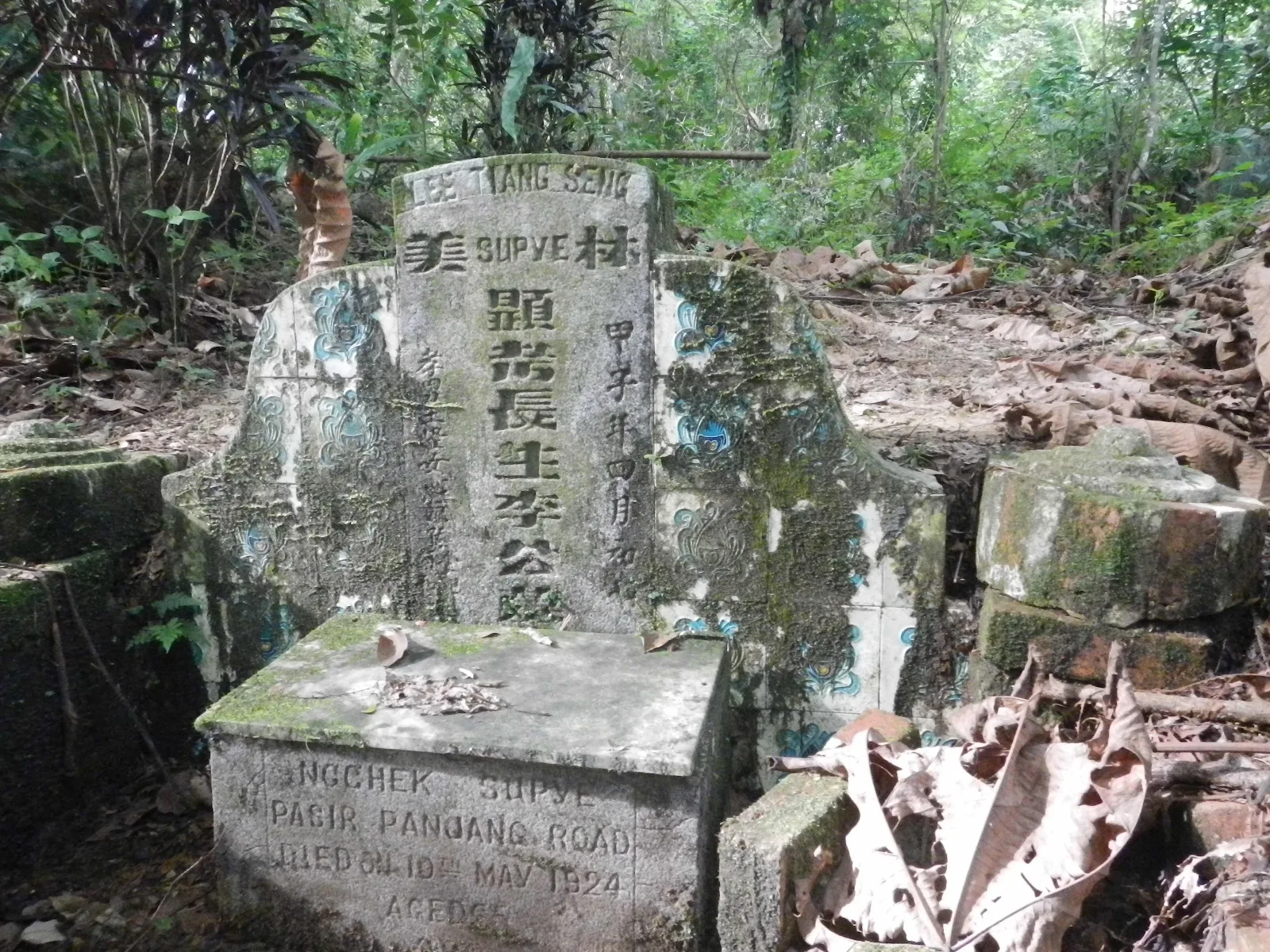
Lee Tiang Seng 
甲子年四月初七
LEE TIANG SENG
李長生
(Father of Lee Geok Leong)
甲子年四月初七
LEE TIANG SENG
SUPYE
林美
顕考長生李公墓
孝男
玉隆 Lee Geok Leong
女
心娘 Lee Sim Neo
孫
金記 Kim Kee
朝和 Teow Hoe
NGCHEK SUPYE
PASIR PANJANG ROAD
DIED ON 10th MAY 1924
AGED 65
D37
Burial Entry
Lee Tiang Seng
Burial Entry
Lee Tiang Seng
Date of death : 10.5.24
Date of internment : 14.5.24
Block 1 Div D plot No 37
Age 65 years
Date of internment : 14.5.24
Block 1 Div D plot No 37
Age 65 years
Lee Tiang Seng would be born circa 1859
金記 Kim Kee
朝和 Teow Hoe
---------------------------------------------------------
---------------------------------------------------------
A Peranakan Butterfly Lovers: A Summary of Sam Pek Eng Tai (1924)
The Disguise and the Journey
Siow Hay Yam's 1924 Baba Malay adaptation of Sam Pek Eng Tai transforms the beloved Chinese Butterfly Lovers legend into a distinctly Peranakan story. Serialized in 38 instalments in Kabar Slalu between January and April 1924, the poem follows Eng Tai, the daughter of a wealthy family, who disguises herself as a young Baba gentleman in order to pursue an education at Hang Chew (Hangzhou).
During her journey she meets the kind-hearted scholar Sam Pek, and the two become sworn brothers. Unaware that Eng Tai is a woman, Sam Pek shares meals, lodgings and school life with her, giving rise to a succession of humorous misunderstandings and affectionate episodes that form the heart of the story.
During her journey she meets the kind-hearted scholar Sam Pek, and the two become sworn brothers. Unaware that Eng Tai is a woman, Sam Pek shares meals, lodgings and school life with her, giving rise to a succession of humorous misunderstandings and affectionate episodes that form the heart of the story.
A Localised Peranakan World
Rather than simply translating the Chinese legend, Siow Hay Yam reimagines it within the everyday world of the Peranakan community. Chinese settings are replaced with familiar places such as Kampong Bali, Kampong Malacca, Geylang, Malacca, Palembang and Singapore. The poem is equally rich in references to Baba cuisine, including chap chye, pongteh, otak-otak, nasi lemak, kari Kling, and many local fruits and delicacies. These details transform the legend into a vivid portrait of Peranakan life in the early twentieth century.
Chek Supye and the Living Community
Among the most intriguing episodes are the celebrated culinary pantuns, in which the poet praises the cooking of several well-known members of the Peranakan community, including Wak Chiok Nyonya, Wak Sugi, Nenek Kandang, Nenek Pungot, Bih Kim, Bih Yian and Chek Supye. One famous stanza reads:
Anak udang di buat chapchya,
Takda kobi di champorkan pekchye,
Orang bujang bini Chek Supye,
Panday s'kali masak laok Kiah Sye.
Based on my research at Bukit Brown Cemetery I have reasons to believe that Chek Supye was Lee Tiang Seng (Encik Supye), who died on 10 May 1924, only weeks after the serial concluded. His appearance in the poem suggests that Siow Hay Yam may have incorporated real members of the contemporary Peranakan community into his literary adaptation, preserving a remarkable snapshot of the people, households and culinary traditions familiar to readers of Kabar Slalu. Other humorous verses mentioning "anak Supye" further reinforce the impression that these were names recognised by the community of the day.
Humour, Satire and Everyday Life
Interwoven with the romance are episodes of comedy, social satire and everyday observation. The poem introduces colourful street characters, eccentric teachers, food stalls, kampong gossip and familiar neighbourhoods, often blending gentle humour with references that contemporary readers would have instantly recognised. These local scenes give the work a unique personality, allowing the legendary romance of Sam Pek and Eng Tai to unfold against the backdrop of 1920s Peranakan society.
A Distinctly Baba Interpretation
Unlike the traditional Chinese version, which concludes with the tragic deaths of the lovers and their transformation into butterflies, Siow Hay Yam's serial ends on a gentler note. After Eng Tai returns home and leaves Sam Pek with the promise of a future reunion, the story concludes without recounting their tragic fate. Instead, the final instalments are followed by a collection of independent pantuns celebrating love, food, humour and community life. The result is not simply a translation of a Chinese classic, but a creative Peranakan reinterpretation that celebrates the language, customs, cuisine and personalities of the Baba community in Singapore and Malaya during the 1920s
References:
1. Kabar Slalu between January and April 1924
References:
1. Kabar Slalu between January and April 1924
2. Sam Pek Eng Tai versi Peranakan Baba by Ding Choon Ming
Comments
Post a Comment