Wee Hap Lee 黃合利 (d. 1896)
Tong'an 同安 Hokkien; headstone dated Guangxu 22 (1896)
Kopi Sua 羔丕山, Mount Pleasant side (Hokkien Huay Kuan burial ground)
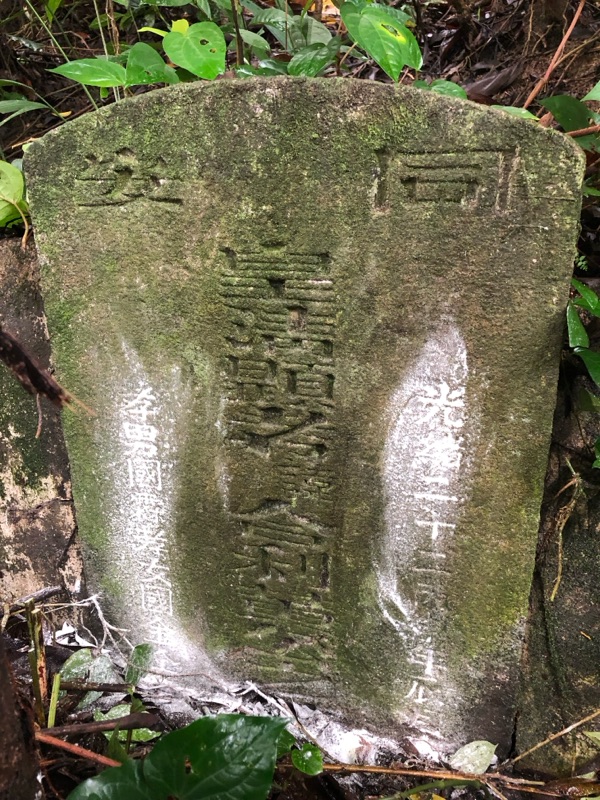
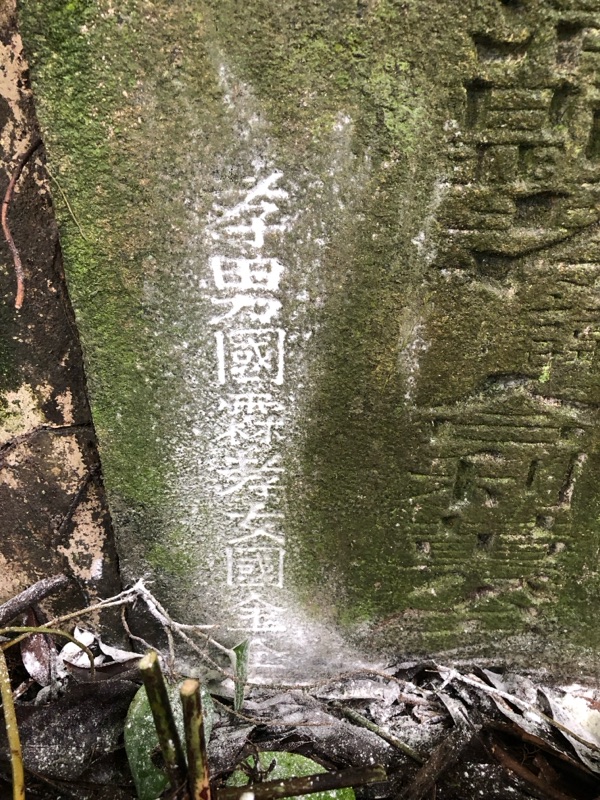
Tomb inscriptions:
同安
光緒二十二丙申年瓜月
孝男
國霖 Wee Kok Lim
孝女
國金 Wee Kok Kim
Summary: Wee Hap Lee 黃合利 (also spelt Wee Hup Lee) died in 1896, in the 22nd year of the Guangxu reign, and is buried at Kopi Sua 羔丕山, the Hokkien Huay Kuan burial ground on the Mount Pleasant side. His headstone records his ancestral home as Tong'an 同安 county, Fujian, and names a son, Kok Lim 國霖, and a daughter, Kok Kim 國金, as the people who set up the stone. A Kuala Lumpur funeral report of January 1896 names a Mr Wee Hap Lee as brother of Wee Hap Lang, the miner and secretary to Capitan China Yap Kwan Seng, and of Wee Hap Guan. Wee Hap Lang’s sons in the newspapers carry the same generation character Kok (Kok Chee, Kok Ann, Kok Seng, Kok Chan). A later Wee Kok Lim of Kuala Lumpur, Klang and Kuala Pilah fits the son on the stone. The identification is a strong lead, not yet confirmed. This record transcribes and translates the inscription, converts the date, and sets out the family lead.
Tomb Inscription 墓碑銘文
| 碑文 | Transcription / Meaning |
|---|---|
| 同安 | Ancestral home (籍貫): Tong'an 同安 county, Fujian 福建, historically part of Quanzhou prefecture and now within Xiamen. Carved at the top of the stone and read from right to left. This records where the family hailed from, not necessarily where he was born. |
| 黃合利 | Centre column, large characters: the name of the deceased, Wee Hap Lee (Hokkien reading of 黃合利; 黃 is Wee, Ng or Huang). Any honorific or phrase before or after the name, such as 顯考 or 之墓, is too worn to read. |
| 光緒二十二丙申年瓜月 | Right column: "the 22nd year of the Guangxu reign, year 丙申 (bingshen), Melon Month". 瓜月 is the literary name for the 7th lunar month. The date therefore falls between 9 August and 6 September 1896. No day is legible. |
| 孝男 國霖 | Left column: "filial son Kok Lim 國霖" (Wee Kok Lim). The generation character 國 (Kok) is shared with his sister, and with the sons of Wee Hap Lang named in the newspapers. |
| 孝女 國金 | "filial daughter Kok Kim 國金" (Wee Kok Kim). No wife or other descendants are named. |
Notes on the inscription:
- A stone with two named children. The stone names a son and a daughter, in that order, and no widow. If the family lead in the biography below is right, both were young when their father died.
- 瓜月. Chinese tomb inscriptions often replace "7th month" with a seasonal name: 瓜月 (Melon Month) is the 7th month, 桂月 (Osmanthus Month) is the 8th. The conversion to 9 August – 6 September 1896 uses the 丙申 year, in which the 7th month began on 9 August.
- The generation character 國. Both children on the stone carry Kok / 國. The same character appears in the given names of Wee Hap Lang’s sons in the English papers: Kok Chee, Kok Ann, Kok Seng and Kok Chan. That is the strongest new support for treating the two men as brothers. It is not proof. No notice yet places Kok Lim or Kok Kim in Wee Hap Lang’s own household.
- Kopi Sua, not Bukit Brown. Kopi Sua is a Hokkien Huay Kuan burial ground, and is distinct from the municipal Bukit Brown Cemetery, which was opened in 1922 for Chinese of all dialect groups. The Huay Kuan's burial ground was earlier known as Heng San Teng 恒山亭, first established by 1828 on Silat Road; Lao Sua, the "New Heng San Teng", was established in 1895, and Lao Sua and Kopi Sua, which lies on the Mount Pleasant side, were among the Hokkien clan cemeteries closed from the 1970s (Culturepaedia; BiblioAsia). An 1896 date is therefore not unusual for this ground, in contrast to the Bukit Brown municipal plots.
- The stone is a plain granite slab with a rounded top, heavily covered in moss; the characters in the centre column are deep-cut and covered in moss, while the side columns have been whitened to make them legible.
Burial Register 埋葬記錄
| Name | Wee Hap Lee 黃合利 (variant: Wee Hup Lee) |
| Dialect group | Hokkien (Tong'an 同安) |
| Date of death | 7th lunar month, Guangxu 22 = between 9 August and 6 September 1896 (stone) |
| Location | Kopi Sua 羔丕山, Mount Pleasant side (Hokkien Huay Kuan burial ground) [add grave number if known] |
| Note | There is no known public burial register for Lao Sua or Kopi Sua, unlike Bukit Brown, so the date and identity rest on the stone alone. Some burial records of the Hokkien Huay Kuan grounds may exist in the National Library, which holds the Singapore Hokkien Huay Kuan collection. |
Short Biography 生平簡介
Almost nothing about Wee Hap Lee himself is recorded, but a family of that name can be traced in the Malay Peninsula. In January 1896, seven months before the date on the stone, a Kuala Lumpur report of the funeral of Mr Wee Hap Guan, an employee of Messrs Howarth, Erskine Ltd, whose offices closed for half a day, names him as the brother of Mr Wee Hap Lang of the Captain China's office and of a Mr Wee Hap Lee (Straits Budget, 28 Jan 1896). A Wee Hap Lee, living and apparently well in January 1896, who died before September of the same year, would fit the stone. The identification rests on the name, and now also on the shared generation character, so it should still be treated as a lead.
The brother named in that notice, Wee Hap Lang, is the Kuala Lumpur miner sketched in Twentieth Century Impressions of British Malaya (1908). He lived at 19 Rodger Street, Kuala Lumpur, and was vice-president of the Selangor Anti-Opium Society and a delegate to the first Anti-Opium Conference at Ipoh. He was the son of Wee Liang Hin and was born in Malacca. His father and grandfather were merchants there. The grandfather was a financier, with an extensive business among the Malays and the Chinese miners. About thirty-five years before the sketch was written, Wee Hap Lang’s father fell sick on an up-country trip and died at Rolro Hill, Kajang. Another member of the family was murdered by the Malays in Perak.
After a training in mercantile houses he entered Government service, resigned in 1894, and started on his own account in Kuala Lumpur. Capitan China Yap Kwan Seng took him as assistant and English secretary, and twice left him in charge of his affairs during visits to China. He remained in that post until Yap Kwan Seng’s death in 1902. He founded the British Malayan Mining Company, Ltd., then just privately floated, and was opening other mining properties. He held mines of his own at Serdang, Sungei Besi, Damansara and Kajang. He was vice-president of the Selangor Chinese Chamber of Commerce, a committee member of the Mandarin School, a trustee of the Anglo-Chinese School, and a member of the Turf Club, the Weld Hill Club and other institutions. He was also one of the originators of the Chinese Christian Association of Singapore. Nine sons and four daughters were born to him, all living in 1908. One son was being educated in England and another in America, and the whole family was being trained in English and Chinese. He and Mrs Wee Hap Lang celebrated their silver wedding on 10 October 1907. The sketch does not name the children.
The newspapers do. In December 1911 Mr Wee Kok Chee, a son of Mr Wee Hap Lang, returned to Kuala Lumpur after studying mining engineering at the Camborne School of Mines (Straits Times, 9 Dec 1911). In December 1912 Master Wee Kok Ann, studying in New Jersey under Bishop and Mrs W. F. Oldham, graduated from Leonia High School (Singapore Free Press, 26 Dec 1912); by December 1915 he had entered Wesleyan University at Middletown, Connecticut (Straits Echo, 23 Dec 1915). In August 1915 a dinner for Mr Wee Hap Lang’s fiftieth birthday was given by his sons-in-law, Messrs Ho, Liang Tian and Tan Kok Quan, and by his son Mr Wee Kok Seng (Straits Echo, 31 Aug 1915). In 1936 Miss Wee Seok Gay Neo, second daughter of the late Mr Wee Kok Seng and a granddaughter of Mr Wee Hap Lang, was engaged to Mr Lee Ek Jim of Seremban (Straits Times, 1 Sep 1936). After Wee Hap Lang’s death in 1938, Sir George Maxwell wrote to Mr Wee Kok Chan of Kuala Lumpur. He called the deceased J.P. a proprietary planter, recalled meeting him more than forty-seven years earlier at the house of Capitan China Yap Kwan Seng, and wrote that “he was a great man and his death is a real loss to the whole of Malaya” (Straits Budget, 24 Nov 1938).
The shared generation character Kok, on both the Kopi Sua stone (國霖 Kok Lim, 國金 Kok Kim) and in Wee Hap Lang’s household (Kok Chee, Kok Ann, Kok Seng, Kok Chan), strengthens the case that the Wee Hap Lee of the 1896 funeral report was this man’s brother. It does not by itself identify the man on the stone. No notice yet places Wee Kok Lim or Wee Kok Kim among Wee Hap Lang’s children.
The children on the stone are matched, separately, by the later career of a Wee Kok Lim. In March 1919 a Wee Kok Lim, who said he had been employed as a clerk-salesman by Messrs Moutrie & Co., sued his former employers in the Kuala Lumpur civil court for salary and commission after being turned out without notice; the defendants applied for a rehearing, and the result has not been traced (Straits Times, 25 Mar 1919; Pinang Gazette, 26 Mar 1919). In April 1920 Wee Kok Lim, secretary of the Klang Club, was reported to be resigning to go into business (Straits Times, 7 Apr 1920), and in January 1921 the Resident of Negeri Sembilan approved Wee Kok Lim, auctioneer of Kuala Pilah, as a second-class appraiser for the State (Straits Times, 7 Jan 1921).
Finally, on 3 January 1933 Mrs Wee Hap Lee (née Teoh Liew Neo), aged 68 and the mother of Mr Wee Kok Lim, died at her residence in Lister Road, Kuala Pilah. Her funeral on 5 January at the local Chinese cemetery was attended by members of the Kong Yee Club, the Chuan Chiew Club and the Boo Teck Huay, and many wreaths and Chinese scrolls were sent (Malaya Tribune, 7 Jan 1933). If she was the widow of the man on the stone, she was about 31 when he died in 1896, which would make the children very young. Her burial at Kuala Pilah and his at Kopi Sua would then show how far apart the family ended up.
The main open question is why a man whose brothers lived in Kuala Lumpur lies in Singapore. He may have died on a visit, or lived in Singapore at the end, or his remains may have been moved later. Any of these would explain a stone set up by a young son and daughter. Because Kopi Sua has no public burial register, this is more likely to be settled by Huay Kuan records, a will, or a Chinese-language notice than by an official register entry.
Newspaper Record 報章紀錄
| Date / Paper | Summary and link |
|---|---|
| 28 Jan 1896 Straits Budget | Selangor: Howarth, Erskine Ltd close their Kuala Lumpur offices for half a day for the funeral on 22 January of Mr Wee Hap Guan, brother of Mr Wee Hap Lang of the Captain China's office and Mr Wee Hap Lee. Possible link to the man on the stone. Read article |
| 1908 Twentieth Century Impressions of British Malaya | Biography of Mr Wee Hap Lang of 19 Rodger Street, Kuala Lumpur: son of Wee Liang Hin, born in Malacca; resigned Government service in 1894; assistant and English secretary to Capitan China Yap Kwan Seng until 1902; founder of the British Malayan Mining Company; mines at Serdang, Sungei Besi, Damansara and Kajang; nine sons and four daughters, unnamed. Silver wedding, 10 October 1907. |
| 9 Dec 1911 Straits Times, p. 8 | Social and Personal: Mr Wee Kok Chee, a son of Mr Wee Hap Lang, who went to England some years ago for his education and to study mining engineering at the Camborne School of Mines, has returned to Kuala Lumpur. |
| 26 Dec 1912 Singapore Free Press, p. 409 | Master Wee Kok Ann, son of Mr Wee Hap Lang, studying in New Jersey under Bishop and Mrs W. F. Oldham, has graduated from Leonia High School; second in a typewriting demonstration and first among the boys in a public speaking contest. |
| 31 Aug 1915 Straits Echo, p. 4 | Mr Wee Hap Lang of Kuala Lumpur celebrates his fiftieth birthday. Dinner given by his sons-in-law, Messrs Ho, Liang Tian and Tan Kok Quan, and his son Mr Wee Kok Seng. Towkay Wong Pin Sam proposes the health. The State band in attendance. |
| 23 Dec 1915 Straits Echo, p. 1840 | Random Notes: Wee Kok Ann, son of Mr Wee Hap Lang, lately of Leonia High School, New Jersey, has entered Wesleyan University, Middletown, Connecticut. |
| 25 Mar 1919 Straits Times | Kuala Lumpur Civil Court: Wee Kok Lim, a clerk-salesman, claims salary and commission from his former employers Messrs Moutrie & Co. after being turned out. Read article |
| 26 Mar 1919 Pinang Gazette | "Clerk's Salary and Commission": the same case. Read article |
| 7 Apr 1920 Straits Times | Social and Personal: Mr Wee Kok Lim, secretary of the Klang Club, Klang, is resigning and going into business. Read article |
| 7 Jan 1921 Straits Times | Wee Kok Lim, auctioneer, Kuala Pilah, approved as a second-class appraiser in Negeri Sembilan. Read article |
| 7 Jan 1933 Malaya Tribune, p. 8 | Death of Mrs Wee Hap Lee (née Teoh Liew Neo), 68, mother of Mr Wee Kok Lim, at Lister Road, Kuala Pilah, on 3 January; funeral on 5 January at the local Chinese cemetery. Read article |
| 1 Sep 1936 Straits Times, p. 12 | Personalia: engagement of Mr Lee Ek Jim, only son of the late Mr Lee Chwee Eng, founder of Lee Kee & Co., Seremban, to Miss Wee Seok Gay Neo, second daughter of the late Mr Wee Kok Seng and Mrs Wee Kok Seng, and a granddaughter of Mr Wee Hap Lang of Kuala Lumpur. Marriage fixed for 19 September. |
| 24 Nov 1938 Straits Budget, p. 24 | Sir George Maxwell’s tribute on the death of Mr Wee Hap Lang, J.P., proprietary planter, written to his son Mr Wee Kok Chan of Kuala Lumpur. Maxwell had met him at the house of Capitan China Yap Kwan Seng more than 47 years earlier, when Maxwell’s father was British Resident of Selangor. |
Sources 資料來源
- Headstone of 黃合利, Kopi Sua 羔丕山, Mount Pleasant side (field photographs and transcription, S.T.E.M.).
- Newspaper articles as listed above, via NewspaperSG, National Library Board, Singapore.
- Arnold Wright and H. A. Cartwright, eds., Twentieth Century Impressions of British Malaya (London: Lloyd’s Greater Britain Publishing Co., 1908), biography of Wee Hap Lang, Kuala Lumpur.
- "Hokkien clan cemeteries in Singapore", Culturepaedia, Singapore Chinese Cultural Centre. culturepaedia.singaporeccc.org.sg
- "The Singapore Hokkien Huay Kuan Collection", BiblioAsia 20:2, National Library Board (on the Huay Kuan's management of Kopi Sua, 1961–73). biblioasia.nlb.gov.sg
- Lunar–Gregorian conversion: the 7th month of the year 丙申 (Guangxu 22) began on 9 August 1896 and ended on 6 September 1896, computed with an astronomical calendar library.

About this record. This entry is part of Singapore Tombstones Epigraphic Materials (S.T.E.M.) 新加坡墓碑銘集录, a specialised digital documentation project and archive recording historical tomb inscriptions in Singapore, with a focus on Bukit Brown Cemetery 武吉布朗坟场, the adjoining Hokkien Huay Kuan burial grounds of Lao Sua and Kopi Sua 羔丕山, and other early Chinese burial grounds. Each record transcribes the original Chinese inscription, gives an English translation, cross-checks it against the burial register, and adds a short biography drawn from contemporary newspapers and archival sources.
Cite this entry as:
Raymond Goh. "Wee Hap Lee 黃合利." Singapore Tombstones Epigraphic Materials (S.T.E.M.), tombs.bukitbrown.org, https://tombs.bukitbrown.org/2018/12/blog-post_16.html. Accessed [date].
Keywords: Wee Hap Lee, Wee Hup Lee, 黃合利, Wee Kok Lim, 國霖, Wee Kok Kim, 國金, Wee Hap Lang, Wee Hap Guan, Wee Liang Hin, Wee Kok Chee, Wee Kok Ann, Wee Kok Seng, Wee Kok Chan, Wee Seok Gay Neo, generation character Kok, Yap Kwan Seng, Sir George Maxwell, Kopi Sua, 羔丕山, Lao Sua, Hokkien Huay Kuan, Heng San Teng, 恒山亭, Mount Pleasant, Bukit Brown, Tong'an 同安, Hokkien, Guangxu 22, 光緒二十二年, 1896, 瓜月, Kuala Lumpur, Kuala Pilah, Chinese tomb inscriptions Singapore, Singapore Tombstones Epigraphic Materials, S.T.E.M.